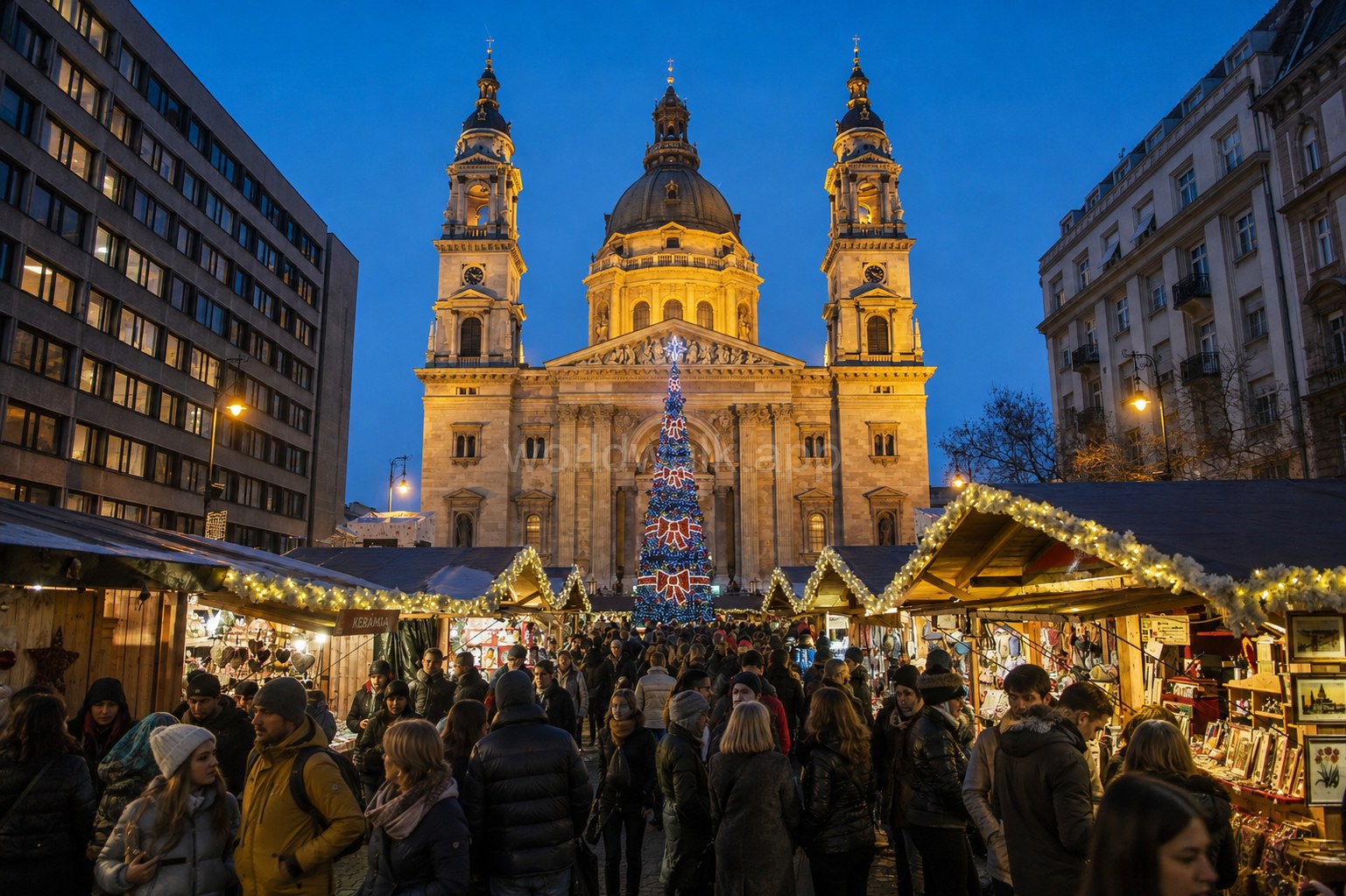
As of now the official 2026 dates haven't been published yet. Both main markets have opened around 14–15 November in recent years and run to about New Year, and operators usually confirm exact dates in early autumn. We've given the expected window below and will update it the moment the dates are official.
Budapest Christmas markets 2026: expected dates
- Vörösmarty Square (Vörösmarty tér) — the oldest and largest. Expected to open mid-November 2026 (around 14 November in recent years) and run into early January 2027. Metro M1 to Vörösmarty tér.
- St. Stephen's Basilica (Advent Feast / Advent Bazilika) — the most atmospheric. Expected mid-November 2026 to around 1 January 2027. Typical hours: Sun–Thu 11:00–22:00, Fri–Sat 11:00–23:00, with reduced hours on 24 December (to around 15:00). Metro M1/M2/M3 to Deák Ferenc tér, then a 5–6 minute walk.
Both are free to enter. You only pay for food, drink, gifts and the ice rink.
The two markets that matter
The two main markets are a 10–15 minute walk apart in central Pest, so the honest answer to “which one?” is: both, in the same outing. But they're not the same.
Vörösmarty Square is the grand one. It's been running since 1998, sits at the top of Váci utca (the main shopping street), and packs around 100–150 wooden chalets around a central food court. What sets it apart is quality control — the market runs a jury/review process, so almost everything sold is genuinely handmade Hungarian craft (ceramics, leatherwork, honey, embroidered textiles) rather than mass-produced souvenirs. Look for the famous Gerbeaud Advent calendar: the windows of the historic café on the square are unveiled one per day through December.
St. Stephen's Basilica is the atmospheric one, and the reason is its free evening light show — an animated 3D projection across the basilica's huge neo-classical facade, running on a loop roughly every half hour from about 17:30 to 22:00, with new choreography each year. Add an ice rink and a towering tree in the square and it's the market people photograph. The food here is the highlight too, leaning into Hungarian street-food specialities.
Simple rule: Vörösmarty for crafts and daytime browsing, the Basilica after dark for the light show.
The smaller markets (and the ones that don't exist)
Beyond the two mains, there are really only a few genuine smaller markets: one up at Óbuda (Fő tér), one in the Buda Castle district near Fisherman's Bastion, and a boutique one at Városháza Park (City Hall Park). That's roughly it.
This is worth saying plainly because a lot of guides list six or more “smaller markets” — and travellers turn up to find several simply aren't there. Don't build your day around a market you read about in an old list; stick to the ones above.
Food and drink to try
The markets are worth visiting for the food alone:
- Kürtőskalács (chimney cake) — the spit-roasted, cylinder-shaped pastry, in vanilla, cinnamon, cocoa or walnut. At the Basilica you'll also find a salted version.
- Forralt bor (mulled wine) — the standard warm-up. Sugar-free mulled wine is usually available at the Basilica market if you need it.
- Lángos — deep-fried dough, classically topped with sour cream and cheese.
- Gulyás (goulash) and other hot stews for a proper meal.
- Pálinka — Hungarian fruit brandy, if you want something stronger than wine.
How much it costs and how it works
Entry is free — wandering the markets costs nothing. You pay for what you eat, drink and buy, and there's a small fee for the ice rink at the Basilica. Card payment is widely accepted, but carry some cash for smaller stalls. Budapest is noticeably cheaper than the Vienna or Prague markets, which is part of why it's such a good-value winter city break.
One easy day: both markets plus a thermal bath
The classic Budapest winter combination, and it works beautifully:
- Late morning / afternoon: browse Vörösmarty tér for crafts and a first chimney cake.
- Late afternoon: soak at a thermal bath — Széchenyi's outdoor pools stay warm year-round, and steam rising into the cold air is the whole point.
- After dark: walk to St. Stephen's Basilica for the light show and dinner from the food stalls.
- Evening: finish in a ruin bar in the old Jewish Quarter.
Practical tips
- Best time to go: the Basilica after dark for the light show; Vörösmarty in daylight for the crafts. Weekday evenings are calmer than weekends.
- Christmas Eve (24 December): both markets close early, generally by mid-afternoon. Most run through to around 1 January.
- Getting there: both main markets are a short walk from Deák Ferenc tér, where all three metro lines meet — the easiest hub to aim for.
- Dress warm: December in Budapest is cold and damp; the mulled wine only does so much.
Two markets, ten minutes apart, a light show and a thermal bath to warm up in between — Budapest is one of the easiest Christmas-market cities to do well in a single day. Let the WorldWalk Nearby bot fill in what you're walking past along the way.
Frequently Asked Questions
Are Budapest's 2026 Christmas market dates confirmed yet?
Not as of early August 2026. Based on the pattern of recent years, expect markets to open around mid-November and run through New Year's — we'll update this page once the city publishes official dates.
Is it free to walk around the Christmas markets?
Yes, entry is free at both Vörösmarty Square and the Basilica market — you only pay for food, drinks, and what you buy.
Which market should I visit if I only have one evening?
St. Stephen's Basilica market for the light show and atmosphere; Vörösmarty if gift shopping and food variety matter more to you. Ideally, do both — they're a ten-minute walk apart.
Can I pay by card at the markets?
Generally yes at the main food and drink stalls in both major markets. Smaller craft stalls, and the markets at Óbuda or Ferenc tér, are more likely to prefer cash.
Is the Basilica light show every night?
Yes, it runs nightly during the market's operating dates, roughly every 30 minutes from around 17:30 onward.