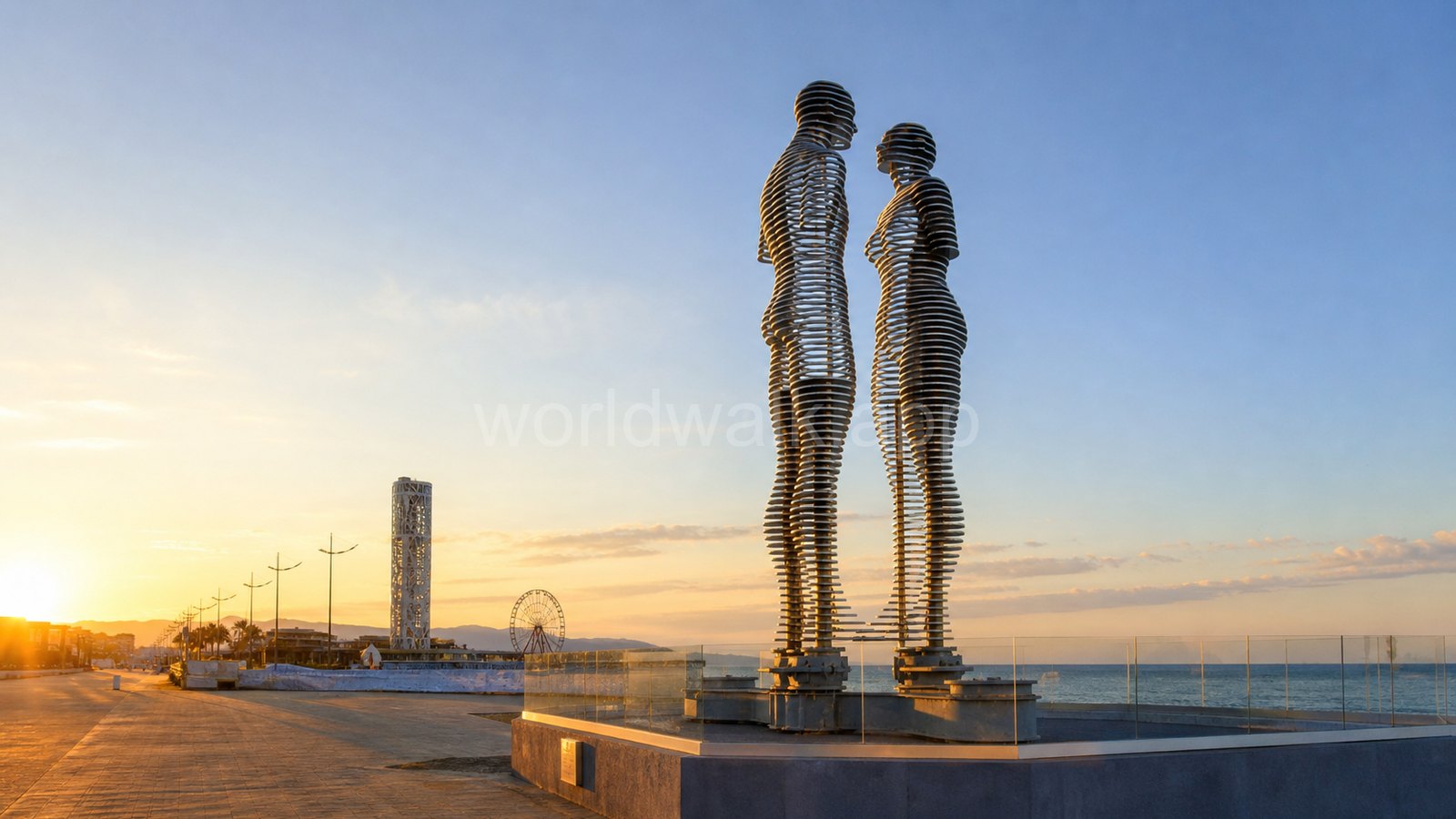
What is it? A kinetic sculpture of two figures, roughly seven to eight metres tall, built from horizontal steel plates that rotate on a shared axis.
Who made it? The Georgian sculptor Tamara Kvesitadze. The work is formally titled Man and Woman; everyone in Batumi calls it Ali and Nino.
Where? On the seafront at Miracle Park, near the Alphabet Tower, at the southern end of the Boulevard.
When does it move? It starts moving when it gets dark; there is no fixed schedule. A full cycle takes several minutes and repeats. Give it at least ten minutes.
Best time to see it: after dark, when it is lit — it is the single most photographed thing in Batumi at night.
Cost: free, outdoors, always accessible.
The Story Behind the Name
The sculpture takes its popular name from Ali and Nino, a novel published in Vienna in 1937 under the pen name Kurban Said. It is a love story between a Muslim Azerbaijani man and a Christian Georgian princess, set in Baku in the years around the First World War and the brief independence of the Caucasus republics.
The relationship in the book is impossible in the ordinary sense — different faiths, different worlds, and a war that eventually decides the matter. That is the emotional logic the sculpture reproduces: two figures that move towards each other, briefly occupy the same space, and then keep going in opposite directions.
The authorship of the novel is still argued over — several candidates have been proposed and none conclusively established, which is a very Caucasus footnote for a book about identity.
How It Works
The figures are built from stacked horizontal steel sections, each mounted on a central axis and able to rotate independently. As the mechanism turns, the outlines shift: what reads as a solid human figure from one angle dissolves into layered slices from another.
The cycle brings the two figures together, passes them through each other, and returns them to their starting positions. Watching from the side, where the layers separate visually, is more interesting than watching straight on.
The sculpture was installed in 2010, and its scale is judged well — big enough to hold the seafront, small enough that you stand close to it rather than beneath it.
Read also: Batumi Boulevard
When to Go
At night. The lighting is the whole point. From roughly dusk onwards the figures are illuminated and the movement becomes far more dramatic against the dark sea. This is when the crowd gathers.
At sunset. The west-facing seafront means the sculpture is backlit as the sun drops, which is the best light for photographs without the lighting rig.
In the day. It starts moving only once it gets dark, so by day you will most likely see it standing still. Fine if you are passing; not worth a special trip.
Practical note: the mechanism is occasionally stopped for maintenance or in high wind. If the figures are stationary when you arrive, they may simply be paused rather than out of service.
What Is Around It
The sculpture sits in the middle of Batumi's cluster of modern seafront landmarks, which makes it easy to combine:
- The Alphabet Tower — the helical tower with the Georgian alphabet running up it, directly beside the park.
- The Ferris wheel and Miracle Park — the surrounding leisure area.
- The dancing fountains — further along the Boulevard, with evening shows in season.
- The Boulevard itself — the promenade running north from here back towards the Old Town, about a 25-minute walk.
The standard Batumi evening is: dinner near Piazza or the Old Town, walk south along the Boulevard, arrive at Ali and Nino after dark. The Batumi at night guide sets out the full route.
Read also: Alphabet Tower
Why It Works Better Than the Rest of Modern Batumi
Batumi's seafront has a lot of ambitious recent architecture, and some of it is more impressive as an idea than as a thing to stand in front of. Ali and Nino is the exception.
It is not selling anything, it does not require you to buy a ticket or take a lift, and it does one thing extremely well: it turns an abstract idea about separation into a physical event you can watch happen. In a city that mostly asks to be admired from a distance, this is the piece that rewards standing still.
Frequently Asked Questions
Where is the Ali and Nino statue in Batumi?
On the seafront at Miracle Park, at the southern end of the Boulevard, next to the Alphabet Tower.
Who created Ali and Nino?
The Georgian sculptor Tamara Kvesitadze. The work's formal title is Man and Woman.
How often does the sculpture move?
It starts moving when it gets dark, with no fixed schedule, and then runs through a cycle lasting several minutes that repeats. Allow ten minutes to see a full cycle.
Is there an entrance fee?
No. It stands in an open public park on the seafront.
When is the best time to see it?
After dark, when it is lit. Sunset is best for photographs.
Is it based on a real story?
It is named after the 1937 novel Ali and Nino, a fictional love story between an Azerbaijani Muslim and a Georgian Christian set in Baku.
If the sculpture has you curious about the rest of the seafront, the Batumium: Discover the Essence of Batumi self-guided audio tour covers the Boulevard and the Old Town together, with the port and empire history that shaped both.
Start the Batumium audio tour →