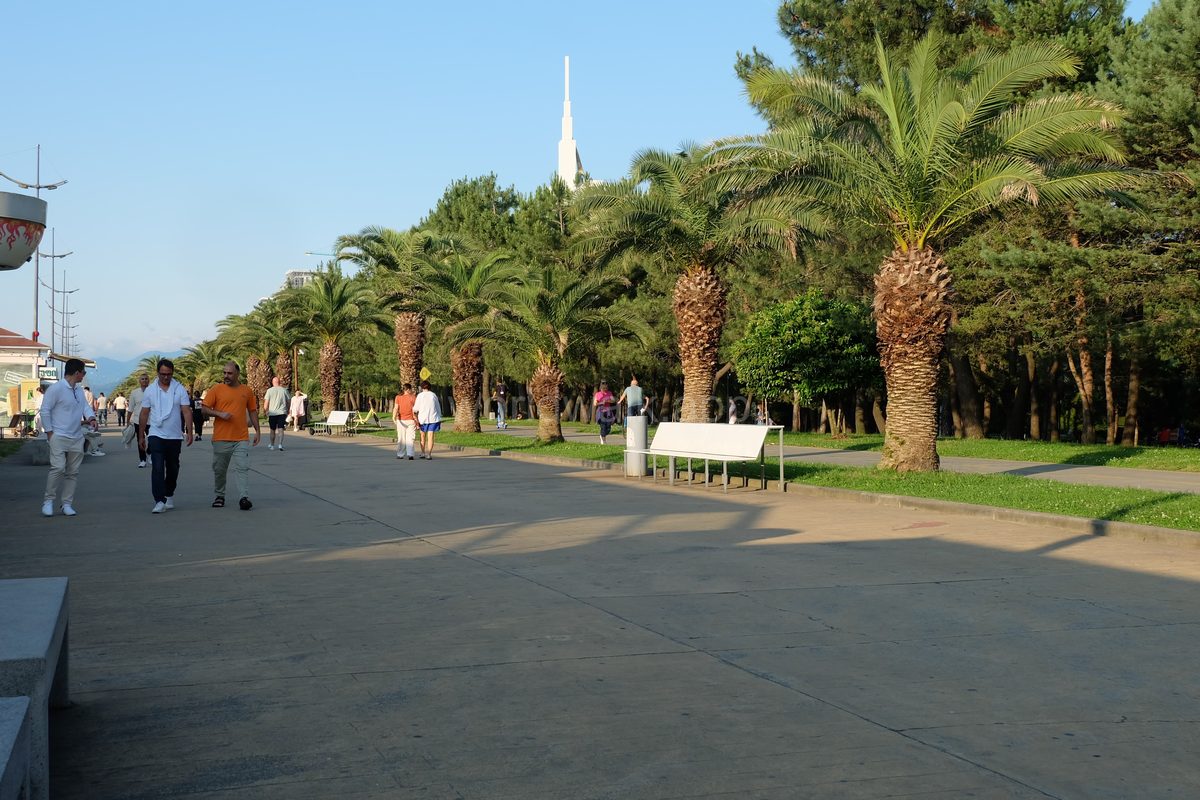
How long is it? Several kilometres, running from the old section near the port south along the coast. End to end is a walk of well over an hour.
Where does it start? The historic section begins near the port and the city beach; the newer section runs south past the Alphabet Tower towards the New Boulevard.
Main sights along it: the Ali and Nino sculpture, the Alphabet Tower, the dancing fountains, the Ferris wheel, the Chacha Tower, the old astronomical clock area and the beaches.
Best time: an hour before sunset until well after dark.
Cost: free. Bike and scooter hire available along the route.
Founded: 1881 — it is considerably older than most of what stands on it.
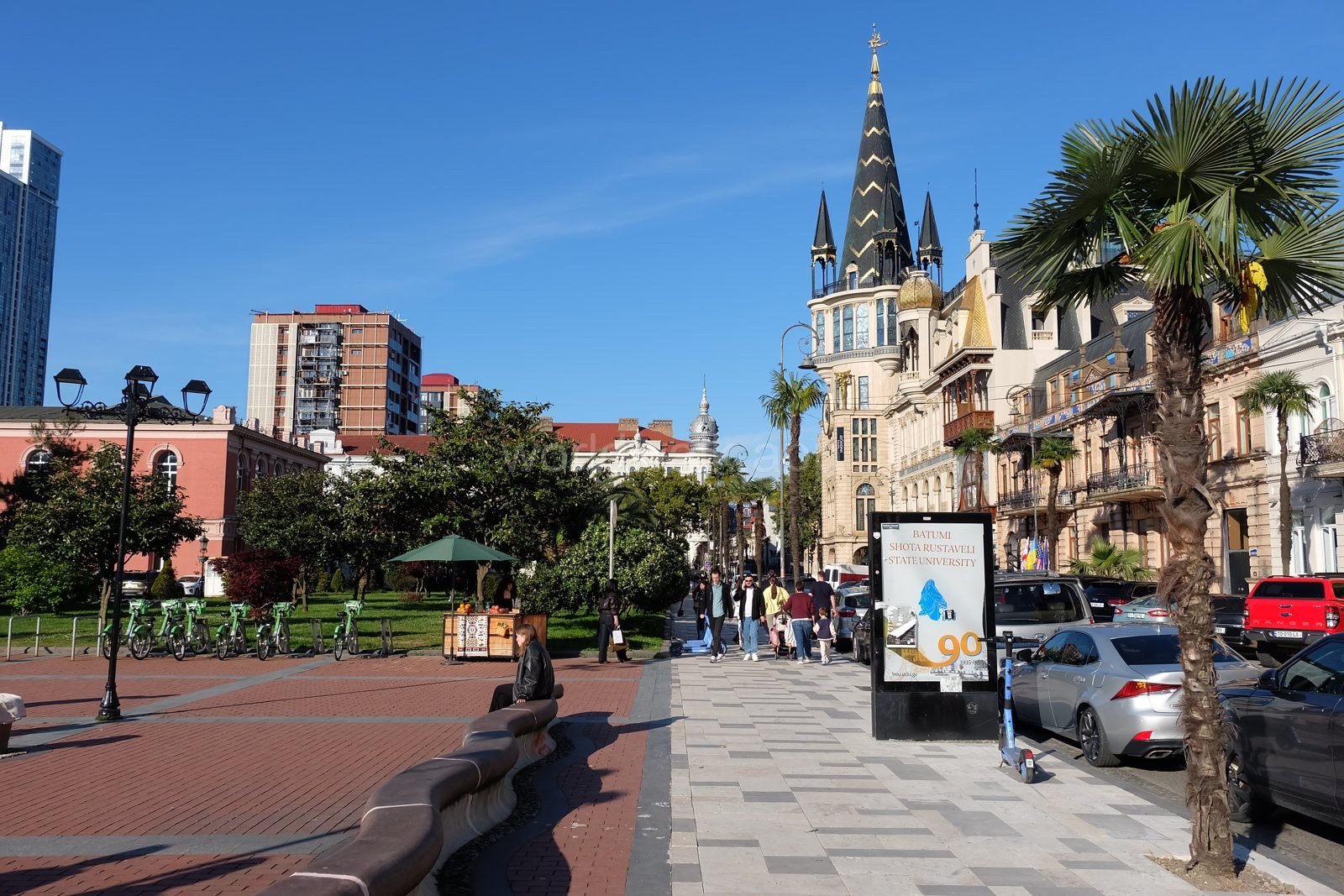
The Old Boulevard
The historic section dates from 1881, when the city authorities began planting a seafront park on what was then swampy coastline. Botanists brought in species from across the subtropics — many of the same collections that later shaped the Botanical Garden up the coast — and the result is a promenade shaded by pines, palms, magnolias and eucalyptus rather than the bare concrete of most Black Sea seafronts.
This older stretch, closest to the Old Town and the port, is the more atmospheric half. It has:
- Mature planting and proper shade — the practical advantage in July and August.
- Café terraces and small pavilions under the trees.
- The city beach running alongside it for its full length.
- Cycle and scooter lanes separated from the walking paths.
- The dancing fountains, with music-and-light shows in the evening during the season.
- Ordinary Batumi life — this is where the city walks in the evening, not just where visitors do.
If you only have time for one part, walk this one.
The New Boulevard
South of the port area the Boulevard continues into its newer extension: wider, more open, less shaded, and lined with the modern landmarks that dominate photographs of Batumi.
Along this stretch you pass:
- Miracle Park, with the Ali and Nino moving sculpture on the water's edge.
- The Alphabet Tower, the helix wrapped in Georgian letters.
- The Ferris wheel and the seafront leisure area.
- The Chacha Tower, a clock tower which, according to a story everyone in Batumi will tell you, was once meant to dispense free chacha from its fountain on set days. It does not.
- The New Boulevard beach, quieter than the central city beach — see Batumi beaches.
The new section is more dramatic and less comfortable: little shade, more concrete, better skyline. It works best in the evening.
How Long Does It Take to Walk?
The old section alone — around 30 to 40 minutes at a slow pace, longer if you stop.
Old Town to Ali and Nino — roughly 25 to 35 minutes on foot.
The full Boulevard end to end — well over an hour of continuous walking, and further than most people expect. In summer heat this is a genuine distance.
By bicycle or scooter — 20 to 30 minutes for the full length. Hire points operate along the route in season, and the flat, separated cycle lane is the best in the city. This is the most efficient way to see the whole thing.
Best Time of Day
Early morning — quiet, cool, and the best time in summer. Runners, swimmers and very few tourists.
Midday in summer — avoid the new section entirely. Stay under the trees on the old Boulevard or go to the beach.
Late afternoon to sunset — the Boulevard's best hour. The sea faces west, so the sunset is directly ahead of you as you walk.
After dark — the fountains, the lit sculptures and the tower, and the whole city out walking. This is the version of Batumi people remember. The full evening route is in Batumi at night.
In rain — the old Boulevard is still walkable under the trees, and considerably more atmospheric than it sounds. See what to do in Batumi when it rains.
Practical Notes
- Shade is unevenly distributed. The old section has it; the new section largely does not.
- Bikes and scooters are hired along the route and are the sensible option for the full length.
- Cafés and toilets are more frequent on the old section than the new.
- Cycle lanes are separate from footpaths — and used at speed. Stay out of them when walking.
- The beach runs alongside for most of the length, so a swim can be folded into the walk at almost any point.
- Evening crowds in July and August are substantial around the fountains and Miracle Park. The stretches in between stay comfortable.
Why the Boulevard Matters
Most seaside cities put a road between themselves and the water. Batumi put a park there in 1881 and has extended it ever since, which is the single best decision in the city's planning history.
The result is that Batumi's public life happens outdoors, along the sea, at walking pace — families, teenagers, old men playing backgammon, cyclists, tourists and the whole city moving in one direction as the sun goes down. The Old Town explains where Batumi came from. The Boulevard shows you what it is now.
Frequently Asked Questions
How long is Batumi Boulevard?
Several kilometres — the full walk from the old section to the far end of the New Boulevard takes well over an hour.
When was Batumi Boulevard built?
The original seafront park was laid out beginning in 1881, with subtropical species planted along a formerly swampy shoreline. The newer southern section is a modern extension.
What is there to see on Batumi Boulevard?
The Ali and Nino moving sculpture, the Alphabet Tower, the dancing fountains, the Ferris wheel, the Chacha Tower, the city beaches and several kilometres of subtropical parkland.
Is Batumi Boulevard free?
Yes. Only hire — bikes, scooters, sunbeds — and the attractions along it cost money.
What is the best time to walk the Boulevard?
Late afternoon into the evening. In summer, early morning is the only comfortable daytime option.
Can you cycle on Batumi Boulevard?
Yes — there is a separated cycle lane along the length of it, with hire points in season. It is the fastest way to see the whole promenade.
The Batumium: Discover the Essence of Batumi self-guided audio tour can be started right off the Boulevard and continues into the Old Town, explaining how the port and different communities shaped the city as you walk.
Start the Batumium audio tour →See also: Europe Square in Batumi