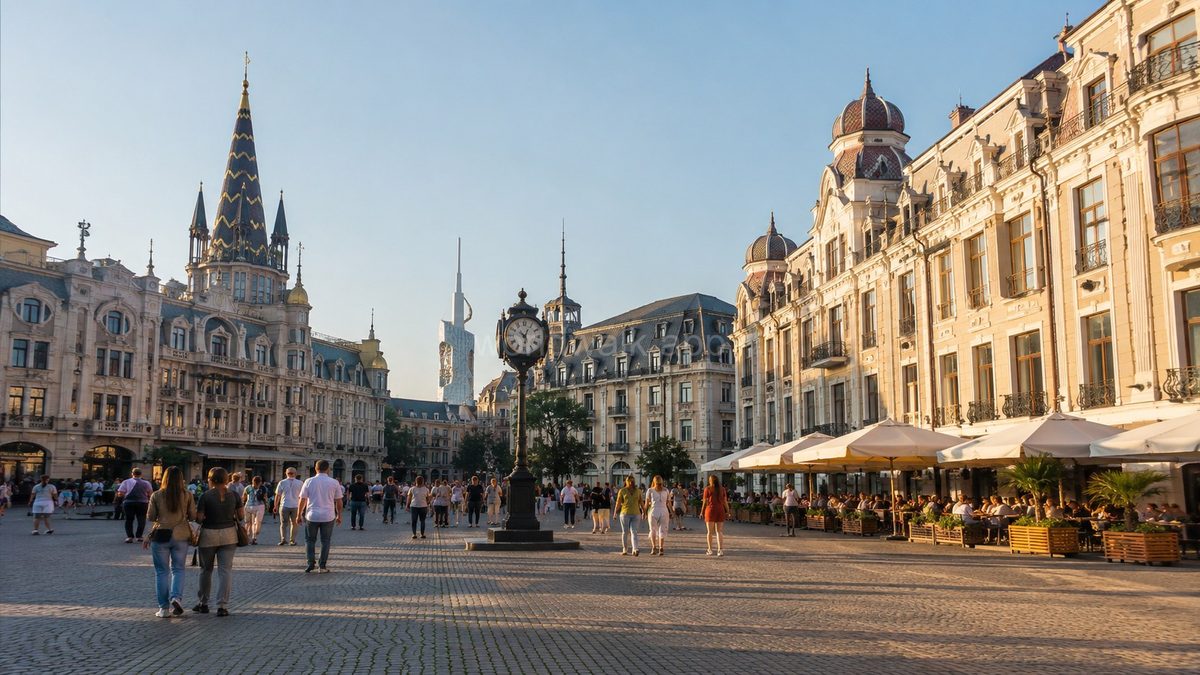
Where? In the centre of Batumi, a few minutes' walk from the Old Town and from Piazza.
What's the statue? Medea, holding the golden fleece, on a tall column at the centre of the square. Unveiled in 2007.
Why Medea? Ancient Colchis, the kingdom in the Greek Argonaut myth, occupied what is now western Georgia. Medea was the king's daughter — and the one who actually made the theft possible.
The clock: an astronomical clock on the facade of the building on the square's edge, one of Batumi's small pleasures if you look up.
Best time: evening, when the square is lit and busy.
Cost: free, open, always accessible.
Medea and the Golden Fleece
The myth is worth two minutes because it puts Batumi somewhere unexpected on the map of European storytelling.
Jason sails from Greece to Colchis — the far eastern edge of the known world for the Greeks — to take the golden fleece from King Aeëtes. The king sets impossible conditions. His daughter Medea, a sorceress, falls in love with Jason and helps him: she drugs the dragon guarding the fleece, and leaves with him.
What follows is one of the darker stories in Greek literature, and Euripides made a tragedy out of it. But the Batumi statue is not about the ending. It shows Medea in the moment of triumph, arm raised, fleece held above her head — a Colchian figure, on Colchian ground, holding what the Greeks came for.
The message is not subtle: this coast was a destination in classical myth long before it was a Soviet resort. Given that the statue faces a square built to look Viennese, that is a reasonable point to be making.
There is also a practical origin story behind the myth. Ancient Colchis was known for gold, and one traditional method of extracting it from mountain rivers used sheepskins laid in the streambed to catch particles washed down from the hills. A fleece full of gold is a less magical object than the myth suggests, and a more interesting one.
The Square Itself
Europe Square in its present form is recent — laid out and rebuilt in the 2000s as part of Batumi's redevelopment, with facades that reference nineteenth-century European architecture rather than reproducing anything that stood here.
This bothers some visitors and delights others. The honest reading: it is a stage set, and it is a good one. The proportions work, the square is genuinely pleasant to stand in, and it does something useful for the city by giving the centre an obvious gathering point.
Look for:
- The Medea column at the centre.
- The astronomical clock on the facade at the edge of the square — dials showing more than the time, worth actually stopping to read.
- The Neptune fountain and the sculptural detail on the surrounding buildings.
- Café terraces around the perimeter, busy from late afternoon.
Read also: Batumi Old Town Walking Guide
When to Go
Evening is the answer. The square is lit, the terraces fill, and it becomes one of the two centres of Batumi's night — the other being the Boulevard. See Batumi at night for the full evening route.
Daytime is quieter and better for photographs of the architecture and the clock, without crowds in front of the facades.
In rain the arcades and cafés around the edge make it a reasonable place to wait out a shower — a genuine consideration in Batumi. See what to do in Batumi when it rains.
What Is Nearby
Europe Square is the hinge between old and new Batumi, which makes it a natural start or end point for a walk:
- The Old Town — a few minutes west, and the most interesting part of the city. Route in the Old Town walking guide.
- Piazza — the Italianate square with mosaics and a clock tower, five minutes away.
- Orta Mosque — in the Turkish Quarter, a short walk into the Old Town. See the Orta Mosque guide.
- The port and the Boulevard — ten minutes towards the sea.
Almost every walking itinerary in Batumi passes through here, including the one in one day in Batumi.
Frequently Asked Questions
Who is the statue in Europe Square?
Medea, the Colchian princess from the Greek Argonaut myth, holding the golden fleece. The monument was unveiled in 2007.
Why is there a golden fleece statue in Batumi?
Because ancient Colchis — the setting of the Argonaut myth — covered what is now western Georgia, including this coast.
Is Europe Square old?
No. The square in its present form was built in the 2000s, with facades designed in a nineteenth-century European style rather than preserved from that period.
What is the clock on Europe Square?
An astronomical clock on the facade at the edge of the square, showing more than the standard time. Easy to miss if you do not look up.
Is Europe Square worth visiting?
Yes — it is central, free, and the natural hinge between the Old Town and the seafront. It takes fifteen minutes on its own and belongs in a longer walk.
What is the difference between Europe Square and Piazza?
Europe Square is the larger public square with the Medea column; Piazza is a smaller, enclosed Italianate courtyard nearby, built privately in 2009, with mosaics and restaurant terraces.
The Batumium: Discover the Essence of Batumi self-guided audio tour starts nearby and covers the Old Town in full, with the port, oil trade and empire history behind what you are standing in front of.
Start the Batumium audio tour →