Where: Gonio village, about 12 km south of Batumi on the road to the Türkiye border.
How long: an hour to ninety minutes inside. Half a day with a beach stop.
Getting there: marshrutka towards Sarpi, or Bolt in about 20 minutes.
Tickets: a modest entrance fee, paid at the gate. Check current pricing and hours on arrival, as they change seasonally.
Best combined with: Gonio or Kvariati beach, ten minutes further south.
Best time: morning, or late afternoon in summer — the interior is open and hot at midday.
What Gonio-Apsaros Was
The Romans built here because of geography. The Chorokhi valley opens onto the sea at this point, providing a route inland; the coastline south leads towards Anatolia. A fort at Apsaros controlled both.
By the first and second centuries AD it was a substantial garrison — accounts of the period describe a sizeable force stationed here, with bathhouses, an aqueduct, a theatre and the ordinary infrastructure of a Roman military settlement. It sat at the eastern limit of Roman authority, facing the Kingdom of Iberia and the Caucasus beyond.
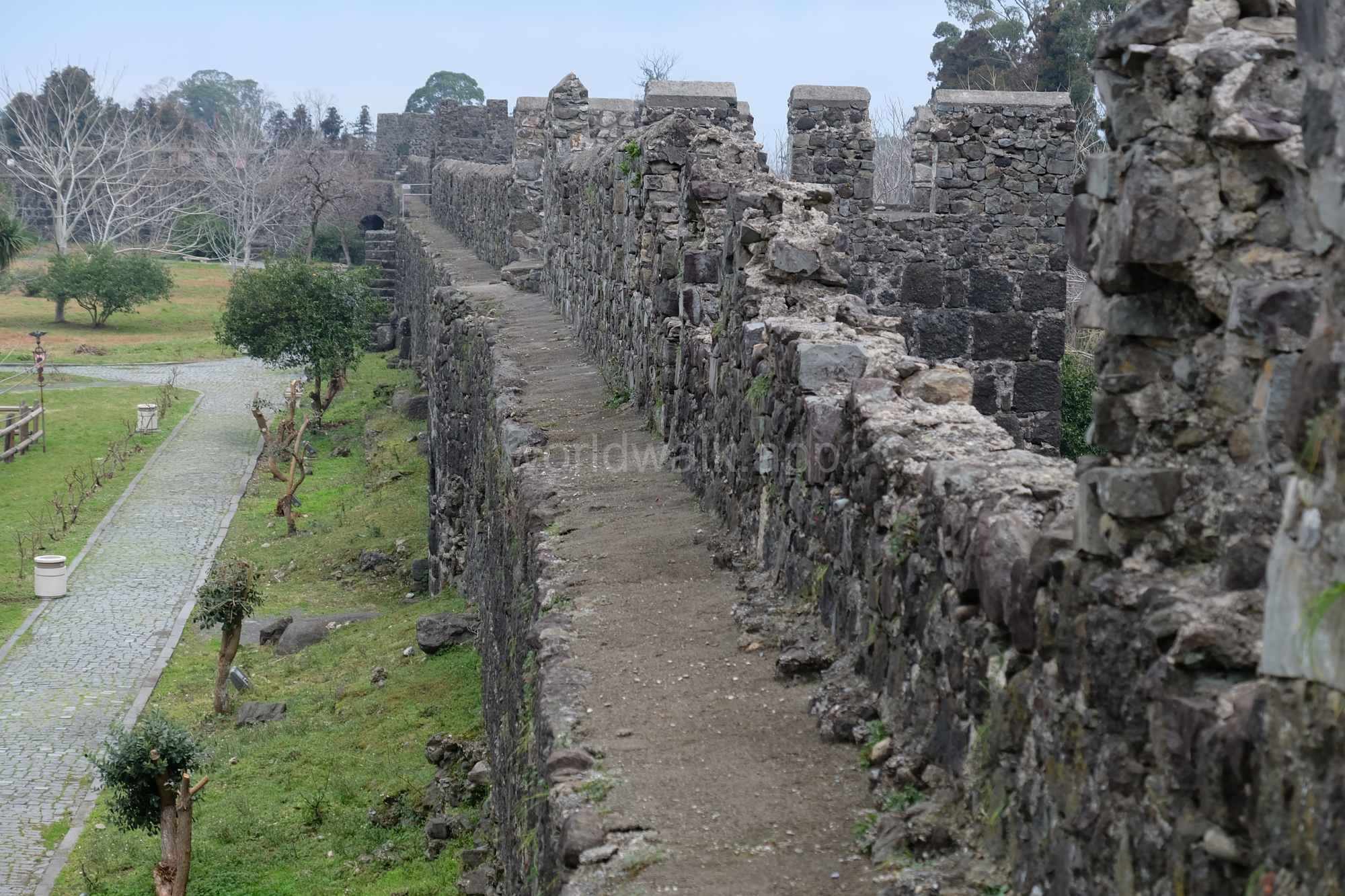
After Rome came Byzantium, which rebuilt and held it; then periods of Georgian control; then the Ottomans, who took it in the sixteenth century and gave the place its present name. The rectangular plan, the corner towers and the sheer thickness of the walls are the accumulated work of all of them.
There is also a tradition — persistent, unproven, and marked on site — that the Apostle Matthias is buried within the walls. A memorial in the northern part of the fortress marks the supposed location. Excavation has not confirmed it, and the local church treats it as a place of veneration regardless.
What You Actually See
The walls. The main event. The perimeter is largely intact, with towers at intervals and a clear sense of the original rectangular plan. Walking the inside of the circuit takes about twenty minutes.
The excavated area. Archaeological work continues, and sections of the interior are opened up — foundations of bathhouses, water systems and buildings from various layers of occupation. Signage is limited, which is the site's main weakness.
The museum. A small building near the entrance holding finds from the excavations: coins, ceramics, glass, jewellery, fragments of everyday Roman-era life on this coast. Worth the fifteen minutes.
The gardens. Much of the interior is grass and planting, which makes the fortress a surprisingly pleasant place to sit. In spring it is genuinely attractive.
The setting. Mountains directly behind, sea a few hundred metres in front. On a clear day the position explains itself.
Read also: Day Trips from Batumi
How to Get to Gonio Fortress from Batumi
Marshrutka. Minibuses heading south towards Kvariati and Sarpi run along the coastal road and stop at Gonio. The fortress is directly beside the road and impossible to miss. The journey takes 20–30 minutes.
Bolt or taxi. About 20 minutes from central Batumi. Simplest option, particularly for two or more people. For the return, order a car from the app rather than using the drivers waiting at the gate — the price difference is noticeable.
Bus. Municipal buses also serve the southern coast. As with all Batumi public transport, fares are paid by card, not cash — see how to get around Batumi.
By car. Parking is available beside the site. The coastal road south is straightforward.
Combining the Fortress with a Beach Day
This is the trip most people should be doing rather than visiting the fortress alone.
Gonio beach is a few hundred metres from the walls: a long pebble beach with cafés and guesthouses behind it, quieter than the city and with clearer water.
Kvariati, five minutes further south, is better still — a small bay with steep green slopes behind it and the clearest swimming within easy reach of Batumi.
Sarpi, at the Türkiye border about ten minutes beyond Kvariati, is the most dramatic setting of the three and the natural end point if you want to see the frontier.
A sensible half-day: fortress at 10:00, beach from midday, back in Batumi by late afternoon. See Batumi beaches for how the southern coast compares with the city.
Read also: Batumi Beaches
Practical Notes
- Shade is limited inside the walls. In July and August, go early or late.
- Wear proper shoes. The interior is uneven grass and archaeology, not paved paths.
- Allow 60–90 minutes. Longer if the museum interests you or you want to sit.
- Signage is thin and mostly in Georgian and English. Reading a little of the history in advance improves the visit considerably.
- Combine, don't isolate. The fortress alone does not fill a day; with a beach or a run down to Sarpi, it makes an excellent one.
Is It Worth It?
If you have three or more days in Batumi, yes. It is the closest genuine antiquity to the city, the trip is short and cheap, and the coast beyond it is the best swimming in the region — so the fortress essentially comes free with a better beach day than you would have had in the city.
If you have one day in Batumi, skip it and walk the Old Town instead.
Frequently Asked Questions
How far is Gonio Fortress from Batumi?
About 12 km south, roughly 20–30 minutes by marshrutka, bus or taxi.
How much does it cost to enter?
A modest entrance fee paid at the gate, with reduced rates for children and students. Prices change periodically — check on arrival.
How long do you need at Gonio Fortress?
One to one and a half hours, including the museum. Half a day if you add a beach stop.
Is the Apostle Matthias really buried at Gonio?
There is a long-standing tradition and a marked memorial inside the walls, but no archaeological confirmation. Treat it as local tradition rather than established fact.
Can you swim near Gonio Fortress?
Yes — Gonio beach is a few hundred metres away, and Kvariati, a few minutes south, has the clearest water on this coast.
Is Gonio worth visiting with children?
In combination with the beach, yes. The fortress interior is open space they can move around in, but there is little in the way of interpretation aimed at children.
Back in Batumi afterwards, the Batumium: Discover the Essence of Batumi self-guided audio tour covers the Old Town on foot, with the more recent history that the Roman walls do not.
Start the Batumium audio tour →