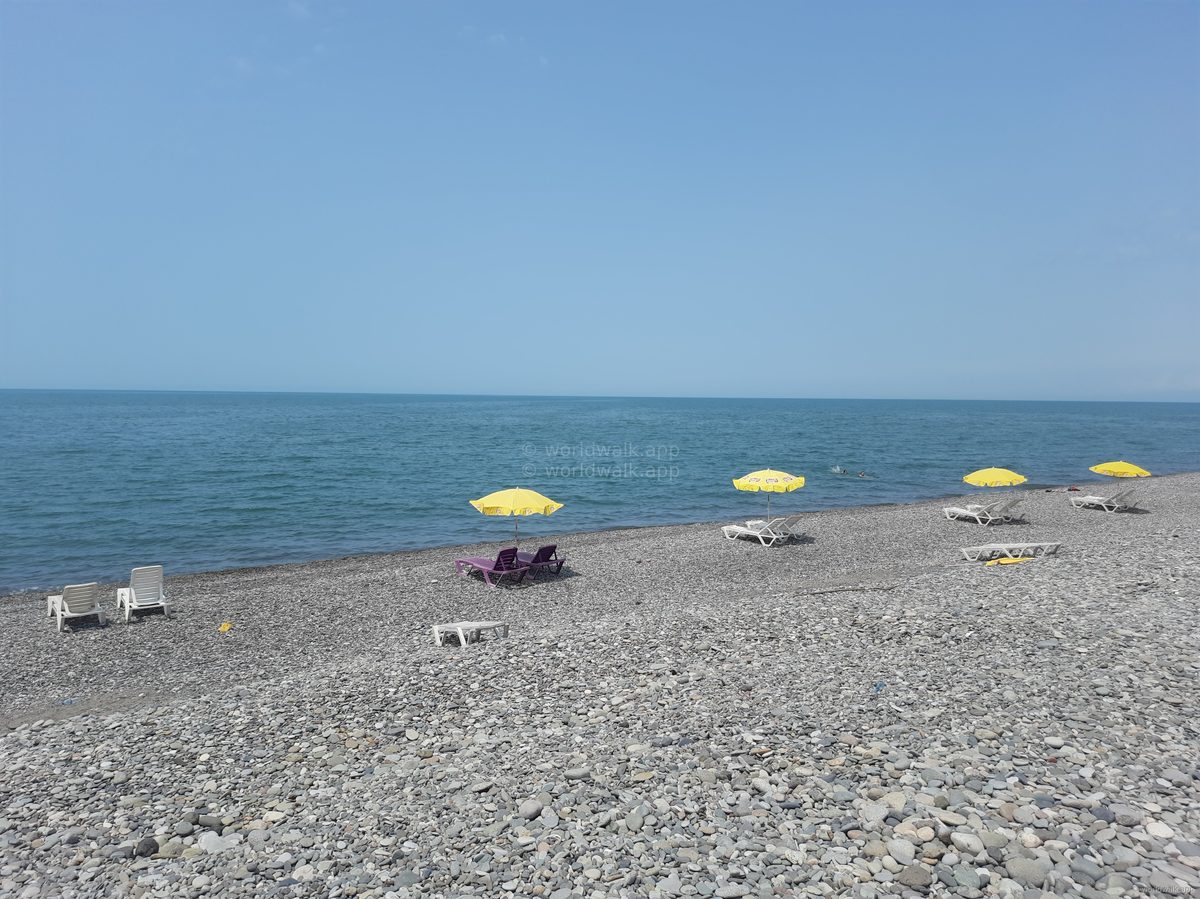
Are Batumi beaches sandy? No. Pebble, throughout the city and most of the nearby coast. Ureki, an hour north, is the sand exception.
Bring: water shoes. Inexpensive, sold everywhere in Batumi, and they transform the experience.
Best beach in the city: the New Boulevard stretch — same water, fewer people than the central section.
Best beach within 30 minutes: Kvariati, south towards the Türkiye border.
Swimming season: roughly June to early October. The sea is warmest in August and September.
Entry: all beaches in and around Batumi are public and free. Sunbeds and umbrellas are rented separately.
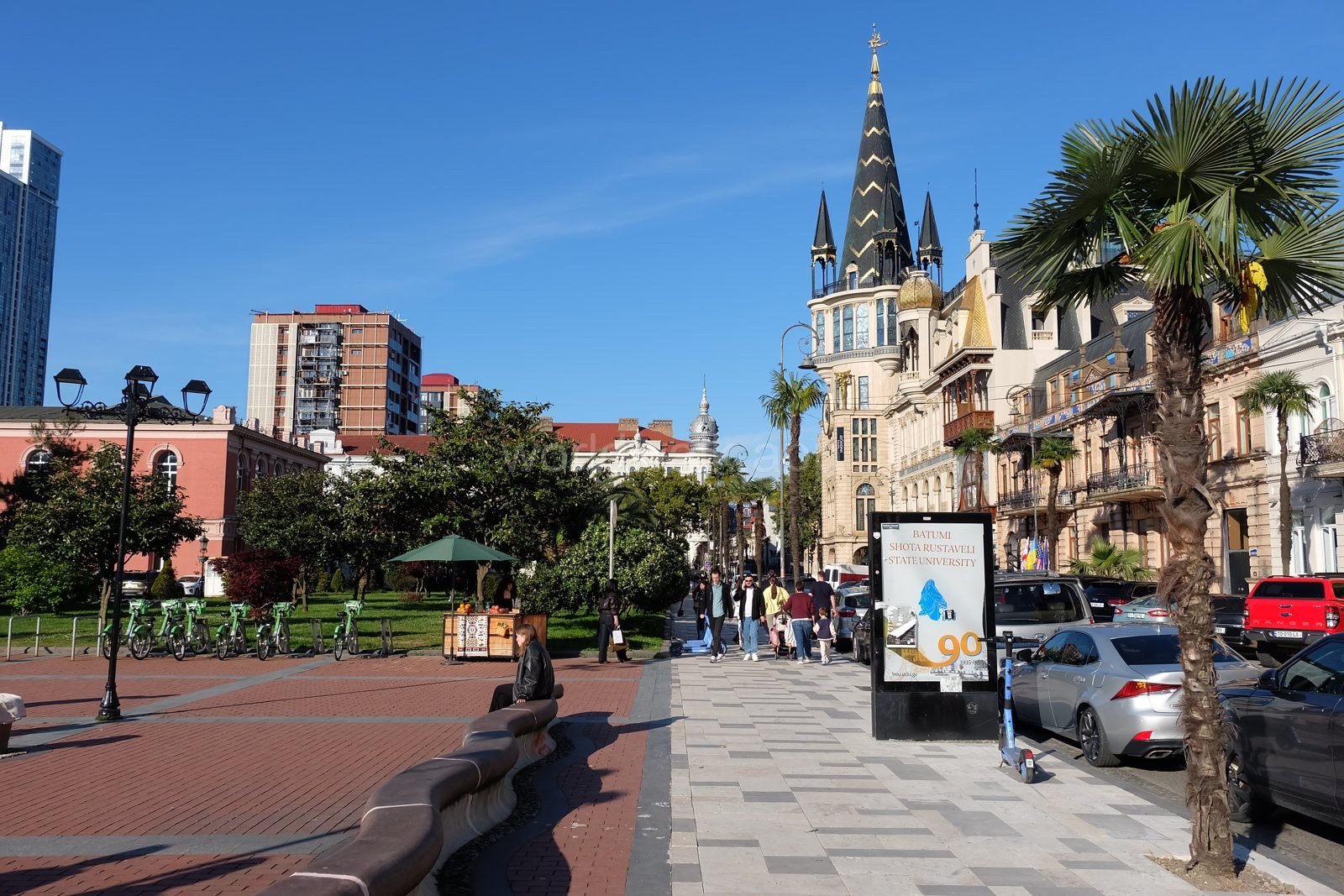
Why the Beaches Are Pebble
Adjara's coast is short, steep and fed by fast mountain rivers — the Chorokhi, the Adjaristsqali — that carry stone down from the mountains rather than fine sediment. The rivers deposit it, the sea rounds it, and the result is the coastline you see.
Two practical consequences. First, the water is unusually clear for a Black Sea city beach, because there is very little fine material to stir up. Second, the shelf drops away more steeply than on a sandy beach — you are out of your depth sooner than you expect, which matters with children and weak swimmers.
Beaches in the City
Central Batumi Beach (along the old Boulevard)
The main city beach, running alongside the historic section of the Boulevard. Maximum convenience: you can walk here from the Old Town in ten minutes, there are cafés and bars directly behind the beach, showers and changing cabins along the strip, and sunbeds for hire.
In July and August it is busy — this is the beach that everyone staying in the centre uses. Early morning and after 18:00 are considerably more pleasant than the middle of the day.
New Boulevard Beach
Further south along the seafront, past the Alphabet Tower and the newer development. The same pebble, the same water, and consistently fewer people than the central stretch. There are beach clubs and bars along parts of it, and open unserviced stretches between them.
For most visitors staying in central Batumi this is the better daily swim: fifteen to twenty minutes further to walk, and a noticeably calmer beach at the end of it.
Around the Port
Not a swimming area. The working port sits between the Old Town and the northern coast; the beach effectively begins south of it and resumes north at Makhinjauri. Do not plan to swim near the port itself.
Read also: Day Trips from Batumi
Beaches South of Batumi — the Better Water
The coast improves as you move towards the Türkiye border. The mountains come closer to the sea, the settlements are smaller, and the water is visibly clearer.
Gonio
About 12 km south, roughly 20 minutes by marshrutka or Bolt. A long pebble beach backed by a low-rise village, with the Roman Gonio Fortress a few minutes inland. Calmer than Batumi, with enough infrastructure — cafés, guesthouses, sunbeds — to spend a whole day comfortably.
The obvious combination: fortress in the morning, beach in the afternoon.
Kvariati
A few kilometres further south, and for many people the best beach within easy reach of Batumi. A small bay with steep green slopes behind it and clear water — this is where local divers go. Smaller and more enclosed than Gonio, with a handful of cafés directly on the beach.
Busy at weekends in season, quiet on a weekday morning.
Sarpi
The last village before Türkiye, roughly 20 km from Batumi. A narrow beach pressed between a cliff and the sea, with the border checkpoint at the end of it. The water is the clearest on this coast and the setting is dramatic in a way the city beaches are not.
Small, so it fills up in August. Worth the trip anyway.
Beaches North of Batumi
Green Cape (Mtsvane Kontskhi)
Directly below the Botanical Garden, about 20 minutes north. Quieter than the city, backed by greenery rather than apartment blocks, and the natural way to finish a garden visit. Pebble, clear, and modestly serviced.
Makhinjauri
Just north of the port, effectively Batumi's suburban beach. Locals use it; visitors mostly do not. Convenient if you are staying on that side of town, unremarkable otherwise.
Kobuleti
25–30 km north, reachable by marshrutka or train. A long beach of mixed sand and pebble — the sand content is higher than anywhere closer to Batumi — running alongside a straight resort promenade. The atmosphere is slower and more domestic than Batumi's.
Ureki
Roughly 50 km north, and the reason people with children make the trip. Dark magnetic sand, soft underfoot, with a gentle shelf — the opposite of everything else on this coast. The magnetite content is locally credited with health benefits; whatever you make of that, it is the only genuinely sandy beach within day-trip distance.
Read also: Batumi Boulevard
Practical Advice for Swimming in Batumi
Water shoes. The single most useful item. Buy them on arrival if you did not pack them — they are sold on every beach approach for a few lari.
The shelf drops quickly. More so than on sandy beaches. Watch children carefully and do not assume you can stand where the water looks shallow.
Currents and weather. The Black Sea here is usually calm but can change fast, particularly with an offshore wind. Rip currents occur. Pay attention to flags and to whether locals are in the water — if a busy beach is suddenly empty, there is a reason.
Storms. After heavy rain, rivers carry debris and sediment into the sea and the water near the city can turn murky for a day or two. Wait it out or head south.
Jellyfish. Occasionally present in late summer. The common Black Sea species are harmless.
Sun. The humidity here disguises how strong the sun is. Batumi burns people who thought they were fine.
Sunbeds. Rented by the day on serviced stretches. There is always free space to lay a towel — beach access itself is public everywhere.
When Is the Sea Warm Enough?
June — swimmable, and the beaches are not yet full. July and August — peak. Warm sea, hot and humid air, maximum crowds and prices. September — arguably the best month of the year here. The sea holds its summer temperature, the air is easier, and the city empties out. Early October — still swimmable in a good year, especially the first two weeks. November to May — not swimming weather, though the beaches are pleasant to walk and the Boulevard stays busy year-round. See Batumi in November for what the off-season looks like.
For a full seasonal picture, things to do in Batumi in summer covers the peak months in detail.
Frequently Asked Questions
Does Batumi have sandy beaches?
No. Batumi and the coast immediately around it are pebble. Kobuleti has a sand-and-pebble mix, and Ureki, about 50 km north, has dark magnetic sand.
Is the water in Batumi clean?
Generally yes — the pebble bottom keeps it clear. It can become murky for a day or two after heavy rain, when rivers carry sediment into the sea.
Which is the best beach near Batumi?
Kvariati, about 25 minutes south, for water quality and setting. Gonio if you want more space and infrastructure.
Do you have to pay for the beach in Batumi?
No. Beach access is free everywhere. You pay only for sunbeds, umbrellas and services.
When can you swim in Batumi?
Roughly June to early October, with August and September the warmest sea.
Are Batumi beaches good for children?
With care. The pebbles are hard on small feet and the shelf drops quickly. Ureki, with its soft sand and gentle entry, is the better family beach — see Batumi with kids.
Once you are back from the water, the Batumium: Discover the Essence of Batumi self-guided audio tour is a good way to spend the rest of the day — a self-guided route through the Old Town with the history that the beach does not tell you.
Start the Batumium audio tour →