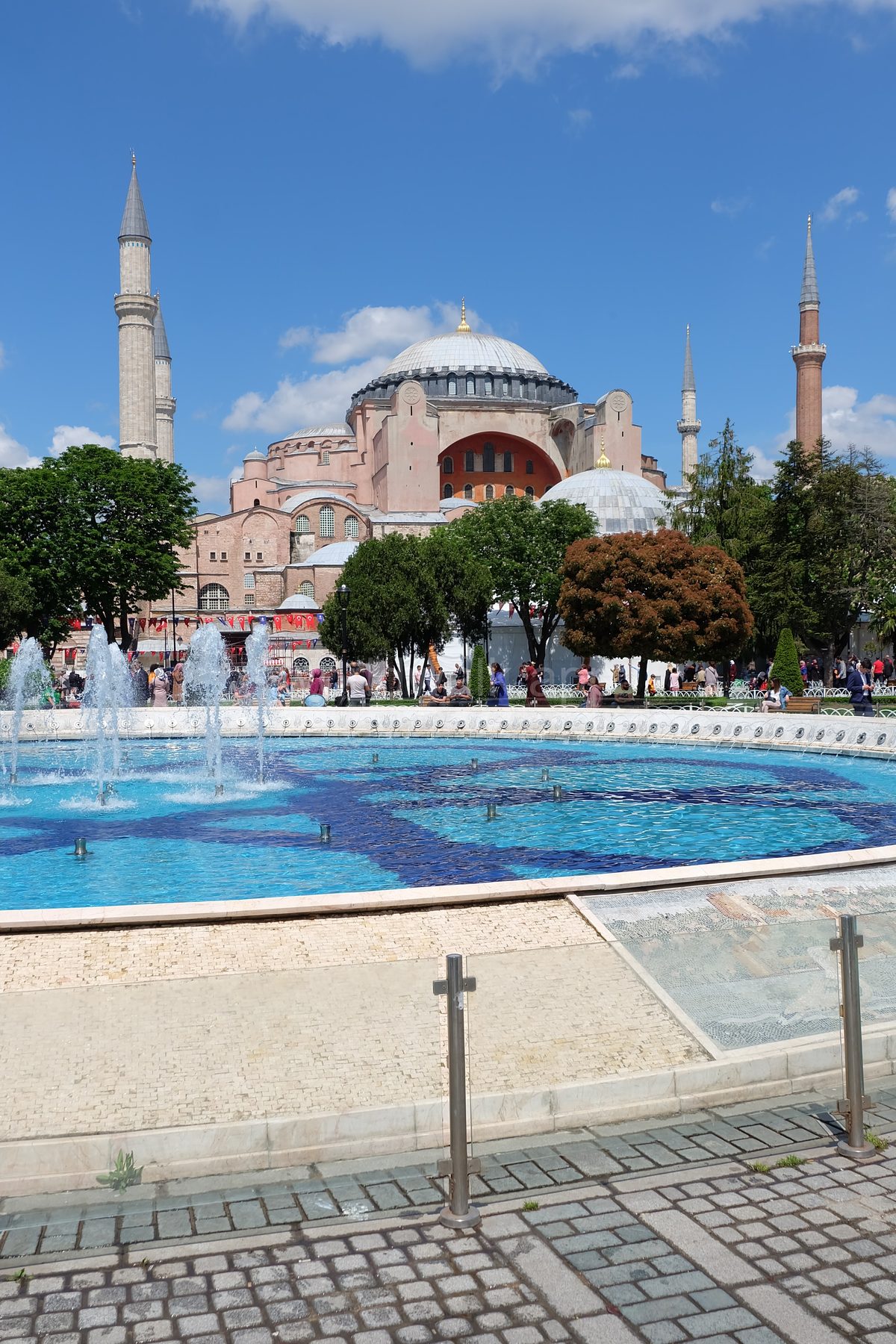
This guide covers how to get in, what the ticket buys, when the building closes to visitors and what to wear. Facts were checked on 2 October 2026; prices and hours can change, so confirm them on the day.
Quick answer
- Status: a working mosque (since 2020), in Sultanahmet.
- Foreign visitors pay €25 (since 15 January 2024). It buys the upper gallery, where the Byzantine mosaics are, through a separate tourist entrance.
- The ground-floor prayer hall is for worshippers. Tourists don't walk across it.
- Museum Pass Istanbul is not valid here. The ticket is separate.
- Children under 8 enter free with ID.
- Hours: open daily, roughly 9:00 to 19:30, with an earlier 8:00 opening from April to September according to published guides. Tourist access pauses five times a day for prayer, and on Fridays it closes for roughly 12:00 to 14:30.
- Dress code: shoulders and knees covered for everyone; women cover their hair.
- Time needed: 30 to 60 minutes inside, plus security and queue time.
A short history
Emperor Justinian I had Hagia Sophia built in 537, and for nearly a thousand years it was the main church of Christendom's eastern half and the heart of Constantinople. After the Ottoman conquest in the 15th century it became a mosque, and minarets were added.
In the 20th century, under the Republic, it became a museum and remained one for decades. In 2020 its status changed again and it became a working mosque, which is why today's rules exist.
Few buildings carry two religions and three empires so visibly. Under one dome, Christian mosaics sit alongside Islamic calligraphy.
Tickets and entry for visitors
What changed in January 2024. Entry for foreign tourists is paid: €25 per adult, introduced on 15 January 2024. Published guides report the price as unchanged in 2026.
How it works now:
- Tourists go to the upper gallery through a separate entrance on the north-east side of the building.
- The upper floor is where the famous Byzantine mosaics survive, so the tourist route leads to the most valuable part.
- The ground floor is the prayer hall. It's reserved for worshippers, who use a different entrance.
- The fee is set in euros and is paid in Turkish lira at the day's rate, which is shown at the ticket office.
- Children under 8 enter free; bring a passport or ID.
- The Museum Pass doesn't work here. Several guides stress this because many visitors assume it does.
You can buy at the ticket booth on the day or in advance online. Be wary of resellers: the price of a skip-the-line ticket from a third party is often noticeably higher than €25, and "skip the line" usually doesn't skip security.
Don't confuse it with the "History and Experience Museum." A separate visitor attraction with a similar name sits near Sultanahmet Square. It's a different building and a different ticket. The €25 gallery ticket is the one for Hagia Sophia itself.
Opening hours
Hagia Sophia is open every day, with no weekly day off. According to published guides, visiting hours are roughly 9:00 to 19:30, starting an hour earlier, at 8:00, from April to September. Treat these as a guide, not a timetable.
The important nuance is prayer. As a working mosque, Hagia Sophia pauses tourist access five times a day for the daily prayers. On Fridays the midday congregational prayer is much longer: tourists are generally not admitted from around 12:00 to 14:30.
For a Friday visit, plan to finish before about 11:45 or arrive after about 15:00. Check the prayer times for the day of your visit.
Dress code and rules
The rules are those of a mosque:
- shoulders and knees covered, for men and women;
- women should cover their hair with a scarf;
- shoes: you remove them when entering prayer areas; ask at the entrance what applies on the gallery route;
- keep your voice down, because people are praying nearby;
- photography is generally allowed, but don't photograph worshippers, and flash is restricted in places.
Scarves and cover-ups are sold at the entrance for a few euros (about €1 for a scarf and €3 for a cover-up, according to one 2026 price guide), but bringing your own is more comfortable.
What you'll see from the upper gallery
The gallery route is not a second-best option. It brings you to the mosaics and gives you a balcony view over the entire prayer hall, which is the best way to take in the scale of the dome.
The mosaics people come to find include the Deësis panel, the Empress Zoe panel and the Komnenos panel. On the way up, the ramp has been worn smooth by centuries of feet.
Even from the gallery, the Islamic elements are as striking as the Byzantine ones: the huge calligraphic roundels and the mihrab that you see from above.
How to avoid the queues
Hagia Sophia is one of Istanbul's most visited places, and queues are normal in the high season. Published guides report that at peak times the ticket and security queues together can take well over half an hour.
What helps:
- arrive at opening, or late in the afternoon;
- avoid Fridays and the minutes before a prayer closure;
- buy your ticket in advance online if you want to save time at the booth, but remember that security checks still apply;
- allow 30 to 60 minutes inside.
What's nearby
Hagia Sophia is in the middle of Sultanahmet, and almost everything else is within walking distance:
- the Blue Mosque is directly across the square;
- the Basilica Cistern is two or three minutes away;
- Topkapi Palace is just beyond the gates;
- the Grand Bazaar is a short tram ride on the T1.
A practical day starts here at opening, then moves to Topkapi before the groups arrive, and leaves the Blue Mosque as the flexible stop around prayer times. For the full price picture of an Old City day, see Istanbul prices in 2026. For the overall plan, see our Istanbul 2026 guide.
Frequently asked questions
Is Hagia Sophia free?
Not for foreign tourists. Since 15 January 2024, they pay €25 to visit the upper gallery. Worshippers enter free through a separate entrance.
Can tourists go onto the ground floor?
No. The ground floor is the prayer hall, reserved for worshippers. The tourist route goes through the upper gallery.
Does the Museum Pass Istanbul cover Hagia Sophia?
No. You need a separate ticket.
How long does a visit take?
Allow 30 to 60 minutes inside, plus time for security and the ticket queue.
When is Hagia Sophia closed to tourists?
For roughly 12:00 to 14:30 on Fridays, and briefly during the five daily prayers.
What should I wear?
Shoulders and knees covered, and a scarf for women. Scarves and cover-ups are sold at the entrance if you forget.
Are children free?
Children under 8 enter free with ID.
Sources and date checked
Checked on 2 October 2026. The sources are third-party travel guides, not an official page, so confirm prices and hours before you go.
- Istanbul.com, Hagia Sophia guide: https://istanbul.com/hagia-sophia
- Hagia Sophia Tickets 2026: https://www.hagiasophia.com/hagia-sophia-tickets
- Wego, Hagia Sophia visitor guide (hours, children): https://blog.wego.com/hagia-sophia-visitor-guide/
- Hagia Sophia Tours, ticket facts (Friday closure, Museum Pass): https://hagiasophia.tours/hagia-sophia-tickets-explained
- Hagia Sophia Tickets, visit guide (north-east entrance): https://www.hagia-sophia-tickets.com/visit-hagia-sophia/
- vc.ru, Istanbul prices 2026 (€25 paid in lira, scarf and cover-up prices): https://vc.ru/travel/3159925-tseny-v-stambule-transport-muzei-i-raskhody