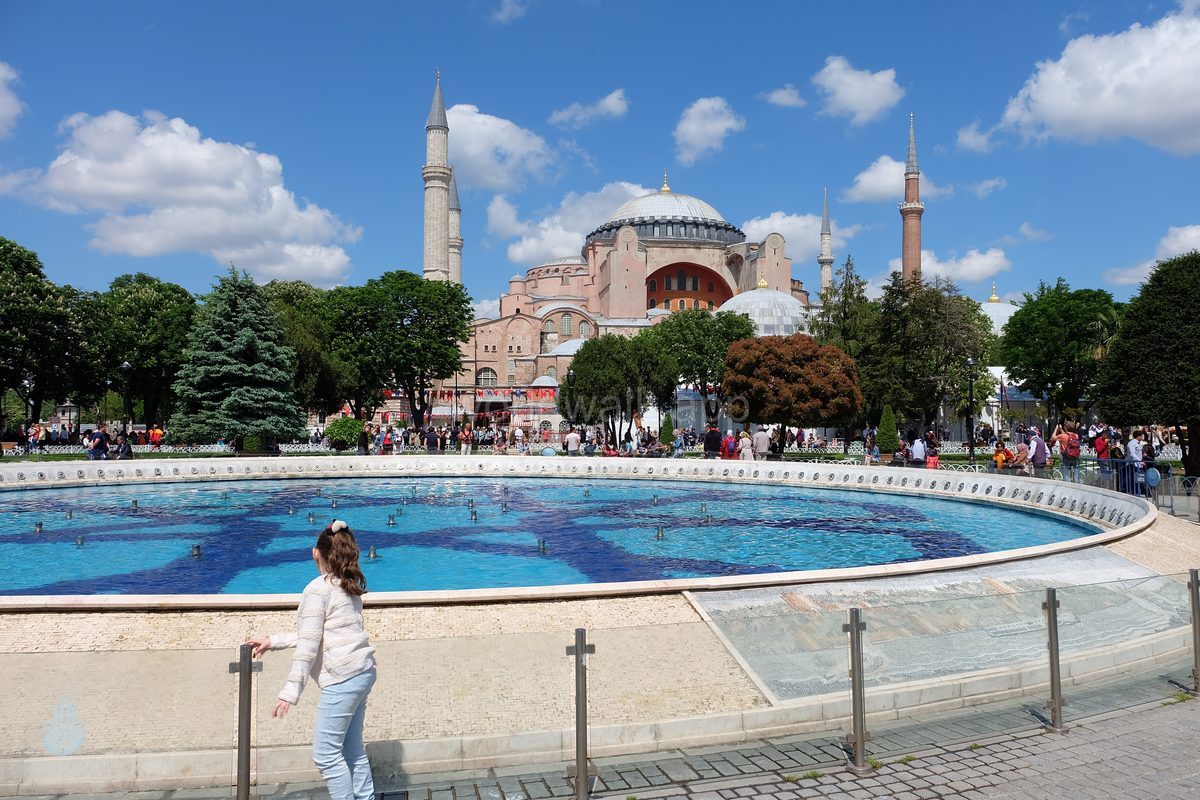
In short: Istanbul essentials
The historic core is Sultanahmet, on the European side: here you'll find Hagia Sophia, the Blue Mosque, Topkapi Palace, the Basilica Cistern and the Grand Bazaar — all within walking distance. The best time to visit is April–May and September–October, avoiding the summer heat. Public transport runs on the single Istanbulkart; cash isn't accepted on it. Of the two airports, the main one is Istanbul Airport (IST) on the European side. Istanbul suits a wide range of budgets.
How the city is laid out
Istanbul makes more sense once you break it down. The city sits on two continents split by the Bosphorus strait: the European side and the Asian side. Most major sights are on the European side.
Key areas for visitors:
- Sultanahmet — the historic heart of old Istanbul: Hagia Sophia, the Blue Mosque, Topkapi, the Cistern, the Grand Bazaar. The logical base for a first visit.
- Beyoglu (Taksim, Istiklal, Galata) — the modern centre: the Istiklal pedestrian street, the Galata Tower, cafes and nightlife.
- The Asian side (Kadikoy, Uskudar) — less touristy, the “everyday” Istanbul, reached by ferry.
The Bosphorus isn't just a border between continents — it's the city's main artery, and a ferry ride across it is essential.
Read also: Hagia Sophia Istanbul: Tickets, Hours, Dress Code and Friday Closure
What to see: the highlights
Hagia Sophia — the city's symbol: once a Byzantine cathedral, then a mosque, then a museum, and now a working mosque again. One of the great buildings in architectural history and a UNESCO site. Foreign visitors pay €25 (since January 2024) and see it from the upper gallery.
The Blue Mosque (Sultanahmet Mosque) — a working mosque facing Hagia Sophia, famous for its blue tilework. Free to enter, with restrictions around prayer times and rules for visitors.
Topkapi Palace — the residence of the Ottoman sultans, a vast complex with a treasury, harem and Bosphorus views.
The Basilica Cistern — an underground Byzantine water reservoir with columns and atmospheric lighting, a striking escape from the heat.
The Grand Bazaar — one of the world's largest covered markets: thousands of shops across dozens of vaulted lanes. Nearby is the Egyptian (Spice) Bazaar.
Galata Tower and Istiklal — the modern centre on the Beyoglu side, with panoramic views and the main pedestrian street.
Sultanahmet's main monuments sit close together and can be walked in a day or two.
When to visit Istanbul
The season shapes the experience.
Spring (April–May) and autumn (September–October) are the best. Warm but without harsh heat, and the city is comfortable to explore on foot. These are also the busiest months.
Summer (June–August) is hot and crowded. See Sultanahmet early in the morning, retreat to museums, cafes or the cool Cistern at midday, and return to the streets in the evening.
Winter (December–February) is cool, rainy and short on daylight, but atmospheric and uncrowded. The rule for a winter trip is to alternate indoors and out: mornings in Sultanahmet, afternoons in a museum or palace, evenings in a hammam or restaurant.
Note that during religious and public holidays the city is busier and some places keep different hours.
Read also: Istanbul Prices in 2026: Tickets, Transport, Food and What a Day Costs
How much a trip costs
Prices and exchange rates shift, so check live figures, but these fixed tariffs give a frame (October 2026): Hagia Sophia is €25 for foreign visitors; Topkapi Palace is 2,750 TL for the combined ticket; an Istanbulkart ride is 46.20 TL; the airport coach is 470 TL. For food, hotels and sample daily budgets, see Istanbul prices in 2026.
Flights are usually the biggest item, driven by season and how early you book.
Accommodation ranges from hostels to luxury Bosphorus views. Sultanahmet is convenient but carries a premium for its location; areas slightly further out are cheaper.
Food spans very budget to expensive. Street food (simit, doner, balik-ekmek) is cheap; view restaurants cost far more.
Transport is inexpensive on the Istanbulkart, and Bosphorus ferries are especially good value.
Attractions are where costs add up: entry to Hagia Sophia, Topkapi and the Cistern is paid, and several sights together are noticeable. Many mosques are free.
Bottom line: Istanbul is budget-flexible. Season, flights and museum tickets shape the total most.
Where to stay
- Sultanahmet — best for a first trip: everything on foot, old-city atmosphere. The downside is that it's very touristy and busy.
- Beyoglu (Taksim, Galata) — the modern centre, cafes, nightlife and good transport links.
- Kadikoy (Asian side) — cheaper and more “real,” but further from the main sights.
For a full breakdown by area, see where to stay in Istanbul.
Transport: the key rule
Istanbul's public transport runs on the single Istanbulkart, valid on the metro, trams, buses, ferries, funiculars and more.
The key point: cash isn't accepted on public transport — you need the card. There's an anonymous card for visitors, bought and topped up from machines at stations, and one card can pay for several people.
- Tram T1 runs through Sultanahmet and the main tourist points;
- the metro is the fastest way between districts, avoiding traffic;
- ferries are the best and cheapest way to cross the Bosphorus and see the city from the water.
Getting in from the airport
Istanbul has two airports:
- Istanbul Airport (IST) — the main one, on the European side, roughly 40–50 km from the centre (guides give figures from about 40 to 52 km depending on the district). Airport buses (HAVAIST), the metro and taxis run into the city.
- Sabiha Gokcen (SAW) — on the Asian side, further from the historic centre; popular with low-cost carriers.
Check which airport your flight uses — it strongly affects the journey to your hotel. Taxis are convenient but pricier; buses and the metro are cheaper.
Visa and documents
Turkey's entry rules vary by nationality: some travellers enter visa-free, others need an e-visa or a visa on arrival. Check your country's current requirements through official sources before booking, as rules can change.
How many days you need
- 2–3 days — the minimum to see Sultanahmet and part of the modern centre.
- 4–5 days — comfortable: the old city, Beyoglu, the Bosphorus, the Asian side and the bazaars without rushing.
- a week or more — with day trips and an unhurried pace.
Practical tips
- Cash and cards: cards are widely accepted, but carry some Turkish lira for markets, street food and small purchases.
- Food: see what to eat in Istanbul. Since 30 January 2026, restaurants can't add service or cover charges to the bill.
- Mosque dress: modest clothing is required for working mosques; women cover their hair; shoes come off at the entrance.
- Bargaining: haggling is expected at the Grand Bazaar.
- Internet: a local SIM or eSIM is handy for maps and transport.
- On foot: Sultanahmet is compact, and walking is the best way to see it.
Seeing the historic centre
Sultanahmet isn't a set of separate stops — it's one of the most history-dense districts in the world: in a couple of hours on foot you pass through Byzantine, Ottoman and modern eras. But without context, it's just beautiful buildings.
WorldWalk is preparing an audio guide to historic Istanbul — a walking route with stories at each point, maps and photos, taken at your own pace. The Istanbul audio guide is currently in development; watch for the launch.
Frequently Asked Questions
What must I see in Istanbul?
Hagia Sophia, the Blue Mosque, Topkapi Palace, the Basilica Cistern and the Grand Bazaar — all in Sultanahmet — plus the Galata Tower and a Bosphorus ferry ride.
When is the best time to visit Istanbul?
Spring (April–May) and autumn (September–October): warm without summer heat, and comfortable to walk. Summer is hot and crowded; winter is cool and rainy but atmospheric.
How many days do I need in Istanbul?
At least 2–3 days for the main sights, ideally 4–5 to see the old city, modern centre and the Bosphorus without rushing.
How do I pay for transport in Istanbul?
With the single Istanbulkart, valid on the metro, trams, buses and ferries. Cash isn't accepted on public transport.
Do I need a visa for Istanbul?
It depends on your nationality — visa-free, e-visa or visa on arrival vary by country. Check official sources for current requirements before your trip.