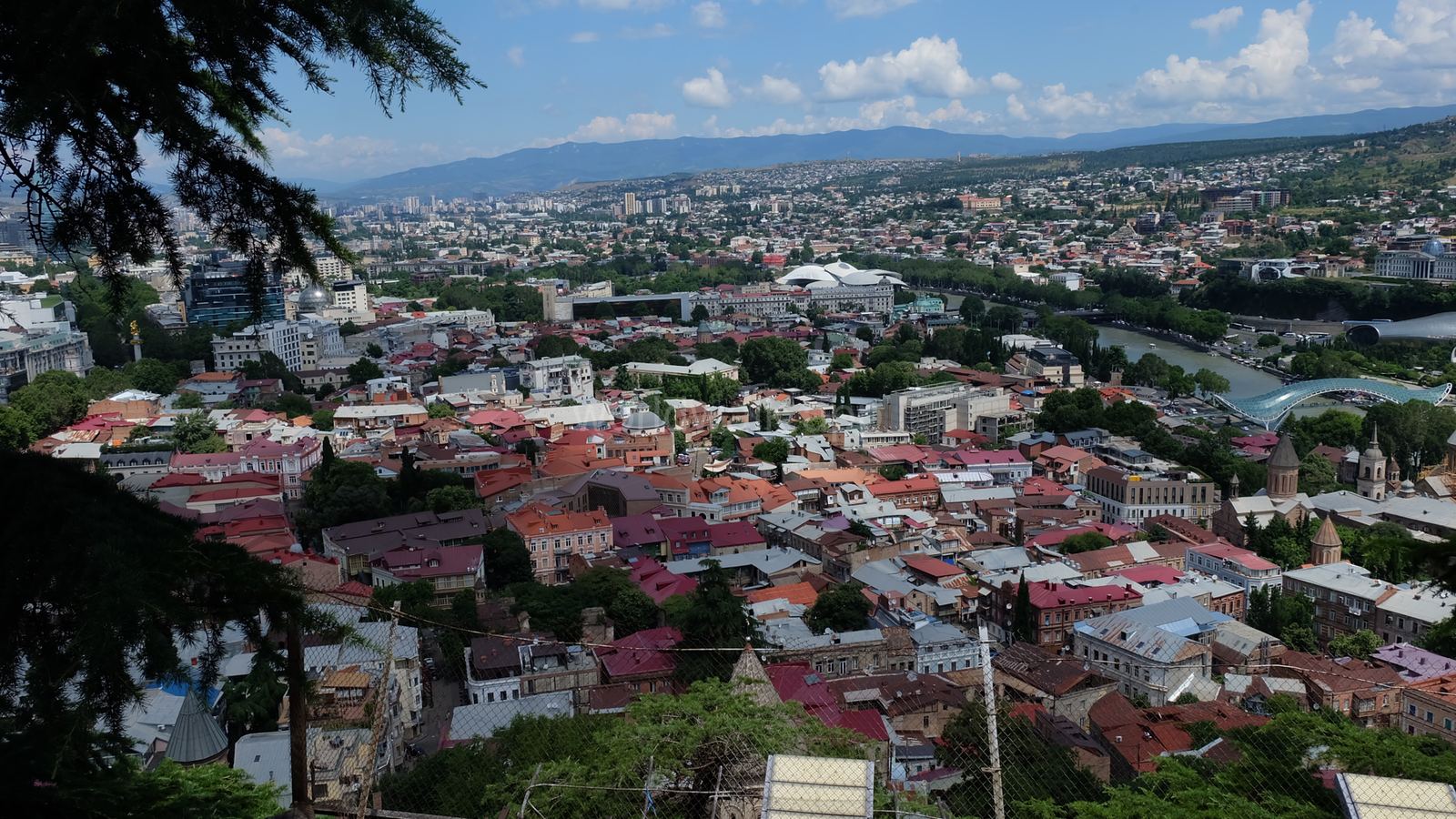
What time is sunset in Tbilisi, month by month
Georgia doesn't switch to daylight saving time, so the city runs on UTC+4 all year. The times below are for the 15th of each month. Aim to arrive at the viewpoint 40–60 minutes before sunset, to get up, find a spot and settle in.
| Month | Sunset (15th) | Set off around | Best spot for the light this time of year |
|---|---|---|---|
| January | 17:54 | 17:00 | Narikala — clear air and sharp shadows on the fortress walls |
| February | 18:31 | 17:35 | Mtatsminda — evenings are rarely windy, and visibility beats summer |
| March | 19:04 | 18:10 | Upper Betlemi Church — the gorge below is still green |
| April | 19:38 | 18:40 | Narikala — clouds after the rain bring a colourful sky |
| May | 20:13 | 19:15 | Mtatsminda — a long warm evening; the city lights come on while you watch |
| June | 20:37 | 19:40 | Turtle Lake — cooler than the centre, and the sun drops behind the ridge opposite |
| July | 20:35 | 19:35 | Mtatsminda — the heat only eases around now, so there's no point going earlier |
| August | 20:00 | 19:00 | Narikala — drier air and less haze over the valley |
| September | 19:08 | 18:10 | Anywhere — the most even light of the year, less heat and fewer tourists |
| October | 18:17 | 17:20 | Chronicle of Georgia — the air over the Tbilisi Sea is especially clear |
| November | 17:38 | 16:40 | Mtatsminda — it gets dark early, but the city lights come on early too |
| December | 17:31 | 16:35 | Narikala — a short day, but the fewest people on the viewpoint |
Viewpoints you can walk up to
Upper Betlemi Church (Zemo Betlemi)
A working Georgian church at the top of the Betlemi stairway — 120 stone steps built in 1850 in the Sololaki district. The terrace in front of the church looks out over the rooftops of the Old Town and the slope of Narikala opposite. A good choice if you want a view without queuing for the cable car or buying a ticket.
How to get there: on foot from Gudiashvili Square or Lado Asatiani Street; the climb takes 10–15 minutes at a relaxed pace.
Cost: free.
When to go: close to sunset, on a weekday — there are fewer people on the steps than on weekend mornings, when tour groups come up.
Downside: the steps are uneven and slippery after rain, so wear closed shoes.
On the map: Zemo Betlemi Church. Checked: August 2026.
The viewpoint by St George's Church of Karapi
A quiet terrace on a rocky slope in the Gomi cul-de-sac. Guidebooks barely mention it, but local photographers know it well. The view takes in the same part of the Old Town as the Betlemi stairway — without a single tourist around.
How to get there: from Betlemi Church, go up Orbiri Street, then into the 3rd Gomi cul-de-sac, No. 7. The way isn't obvious, so check the map on your phone at every turn.
Cost: free.
When to go: at sunset — according to people who have been, that's the time worth making the trip for.
Downside: it really is deserted — not the best choice if you're alone after dark. Come back the same way you walked up in daylight.
On the map: Karapi St George Church
Where the cable car and funicular go
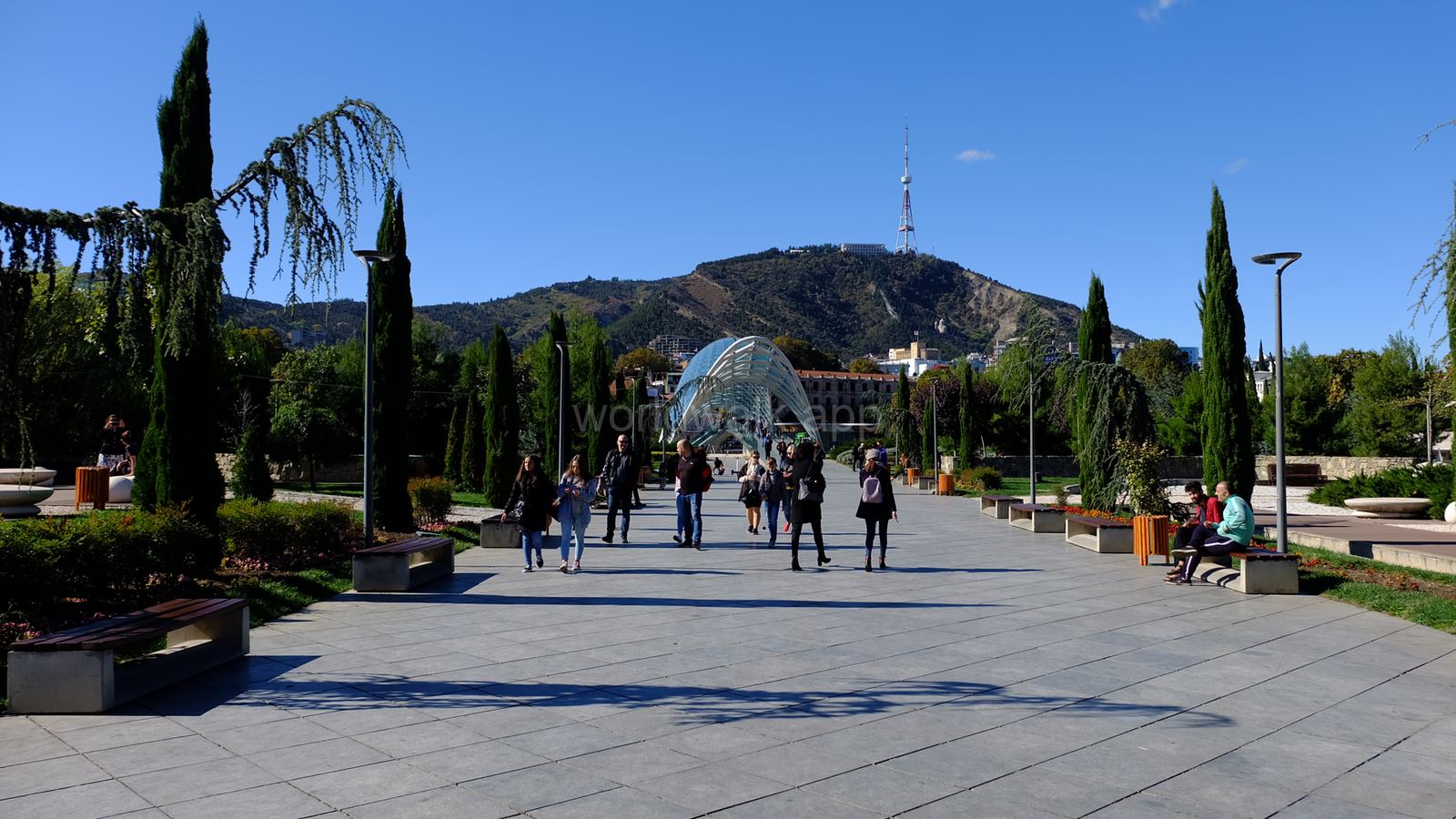
Narikala Fortress and the Mother of Georgia monument
The cable car from Rike Park takes you up to the fortress walls in two minutes. From there, the fortress grounds are free, and a short path leads to the 20-metre Mother of Georgia statue. From the top you can see the whole Old Town, the Bridge of Peace, the parliament building and the river.
How to get there: walk to the lower station in Rike Park (15–20 minutes from Freedom Square or Avlabari), or take buses 341, 344 or 345 to Europe Square. A Bolt from the centre is cheap and quick, but there is little parking right by the park.
Cost: 2.5 GEL (≈ €0.80) one way, payable only with a Metromoney card (the card itself costs 2 GEL at the entrance). The fortress and the monument are free.
When to go: an hour before sunset, on a weekday. On weekend evenings there's a real queue at the lower station — allow 20–30 minutes just for boarding.
Downside: the ticket desk only accepts the card, not cash. If you don't have a card, you can walk down through the Botanical Garden or the bath quarter — a nice route in its own right, but it works downhill, not up.
On the map: Narikala Fortress. Checked: August 2026.
Mount Mtatsminda and the TV tower
The historic funicular, dating from 1905, has three stops: the lower station, the middle station (by the Mama Daviti church and the Pantheon, which is also a free viewpoint) and the upper station by the amusement park and the TV tower. The mountain is west of the centre, so in the evening you're not looking at the setting sun but at the city as it catches the sunset light and gradually switches on its lights. From this spot, the effect is even stronger than looking straight at the sunset.
How to get there: the lower station is on Daniel Chonkadze Street. There's also a road up from the Rustaveli Avenue / parliament side — an option if you don't want to gamble on the funicular's hours.
Cost: sources quote 5 to 12 GEL per ride (≈ €1.70–4). The figure isn't stable, so check on the spot. It uses a separate card; Metromoney doesn't work here.
When to go: an hour to an hour and a half before sunset — allow time for a stroll in the park and dinner at a café.
Downside: the most common mistake is going up late in the evening and discovering the funicular closed earlier than you expected — especially in winter, when hours are shorter. If in doubt, go up by taxi and come down by funicular while it's still running.
On the map: Mtatsminda Park. Checked: August 2026.
Easier by taxi or car
Chronicle of Georgia
Zurab Tsereteli's monument on Keeni Hill, 12–13 km from the centre, above the Tbilisi Sea — a reservoir, not a sea in the literal sense. The view here is completely different from the centre: the reservoir on one side, standard Soviet-era housing on the outskirts on the other. People come not so much for the sunset as for the sheer scale of the monument and a panorama you won't find anywhere else in the city.
How to get there: by taxi or car only, 25–30 minutes from the centre. There's no public transport all the way to the hill.
Cost: free entry, open 24 hours. A Bolt ride costs more than trips within the centre and the fare depends on demand, so check the price in the app before you go.
When to go: during the day, if you want to see the reliefs and the reservoir rather than a silhouette in the dark — the columns are only dimly lit in the evening.
Downside: it's a long way for a single sight, with almost nothing else nearby. Plan it as a separate outing rather than a stop "on the way".
On the map: Chronicle of Georgia
Lesser-known spots
Turtle Lake and the old Vake cable car
Tbilisi's second, lesser-known cable car: open, unglazed cabins running above Vake Park to Turtle Lake. At the top there's a viewpoint, the open-air Museum of Ethnography and a Svan tower. Most guidebooks don't mention this cable car, and it isn't even labelled on Google Maps.
How to get there: the lower station is on Chavchavadze Avenue, by Vake Park. There's no public transport to the lake itself — either the cable car or a walk of about 40 minutes from the nearest stop.
Cost: 1 GEL (≈ €0.30) one way, again with a Metromoney card.
When to go: on a weekday during the day — at weekends the lake is busy and noisy with families.
Downside: there are only two cabins, and the interval between them is longer than on the main cable car, so there may be a queue, though usually a short one.
On the map: Turtle Lake
Each viewpoint: what to expect
A few things that didn't fit into the cards above. Pushchair access is only possible at Narikala and Mtatsminda, where you can ride up to the upper station; beyond that the grounds are cobbled and sloping, so you'll have to push by hand. The Betlemi stairway and the Karapi church are not accessible with a pushchair at all — it's steps and a dirt path only. Toilets and water are available at the upper stations of the cable car and the funicular; at the Chronicle of Georgia and the lesser-known spots there are none, so bring water.
How to photograph Tbilisi from above
The classic shot — the Old Town and the Bridge of Peace — is from the Narikala terrace: shoot from the edge of the wall rather than from the statue, where there are fewer people in the frame. From Mtatsminda, the whole city won't fit into one wide phone shot, so take a multi-frame panorama or find the spot by the Funicular restaurant, where the view is wider. At sunset, backlight is a problem almost everywhere except Mtatsminda — there the sun sets behind you rather than into your lens, which makes it the easiest place to photograph the city without blown-out highlights.
A viewpoint route for one evening
Three spots that combine naturally: start at Upper Betlemi Church (free, 15 minutes to take in the view), walk down to the lower cable car station in Rike Park (20 minutes), ride up to Narikala and watch the sunset there (allow an hour before sunset plus the time to get up). If you still have energy, walk down through the Botanical Garden to the bath quarter and have dinner there.
If you'd rather ride than walk: take the cable car to Narikala before sunset, then a taxi to Mtatsminda — by then the lights are coming on below while you're still up high.
We're working on a Tbilisi audio walk. In the meantime, the free WorldWalk Nearby bot in Telegram shows the landmarks within walking distance of your location — share your location and it lists what's around you, with minutes on foot and a Google Maps link.
Frequently asked questions
What is the best viewpoint in Tbilisi?
There's no single answer: for a panorama of the Old Town, Narikala; for the widest view and the blue-hour effect, Mtatsminda; for quiet without tourists, Upper Betlemi Church or the terrace by the Karapi church.
How much is the cable car in Tbilisi?
The Rike–Narikala cable car costs 2.5 GEL one way, and the Turtle Lake cable car 1 GEL. The Mtatsminda funicular is a separate system; sources quote 5 to 12 GEL, so check on the spot.
What time is sunset in Tbilisi?
It depends on the month — from about 17:30 in December to 20:37 in June. The full month-by-month table is at the top of this article.
How do I get up Mtatsminda?
By the historic funicular from Daniel Chonkadze Street, by taxi on the road up from the Rustaveli Avenue side, or on foot — a steep climb, but with a stop at the Pantheon halfway up.
Are there free viewpoints in Tbilisi?
Yes: the Narikala fortress grounds, Upper Betlemi Church, the terrace by St George's Church of Karapi and the Chronicle of Georgia are all free. You only pay for the cable car or funicular if you'd rather not walk up.