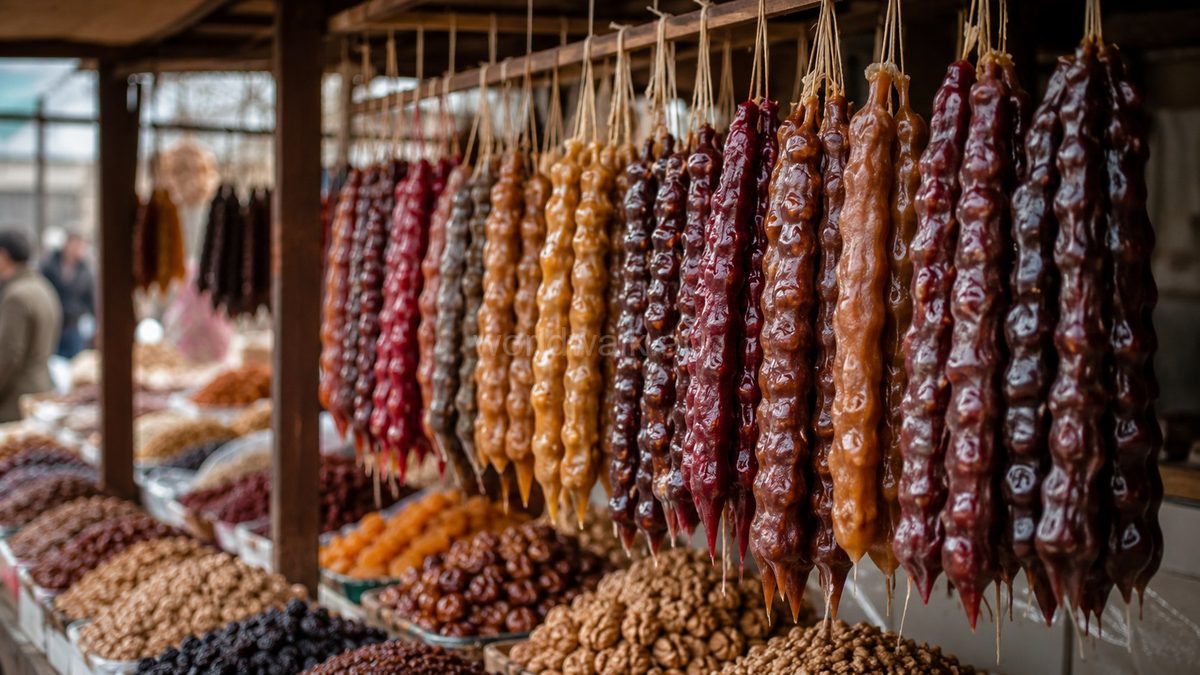
Looking for churchkhela in Batumi? You will find it almost everywhere: tourist streets, small shops and souvenir stalls. For one piece to try, buy it wherever you are. For a big batch of fresh churchkhela to take home as gifts, go to Boni Market: it has the best prices and the widest choice in town.

Quick answer: Churchkhela is a traditional Georgian sweet made from nuts — usually walnuts or hazelnuts — threaded onto a string and dipped in thickened grape juice or grape must. It is then dried until chewy and firm. You will see it in markets, small shops and roadside stalls across Georgia.
What Is Churchkhela?
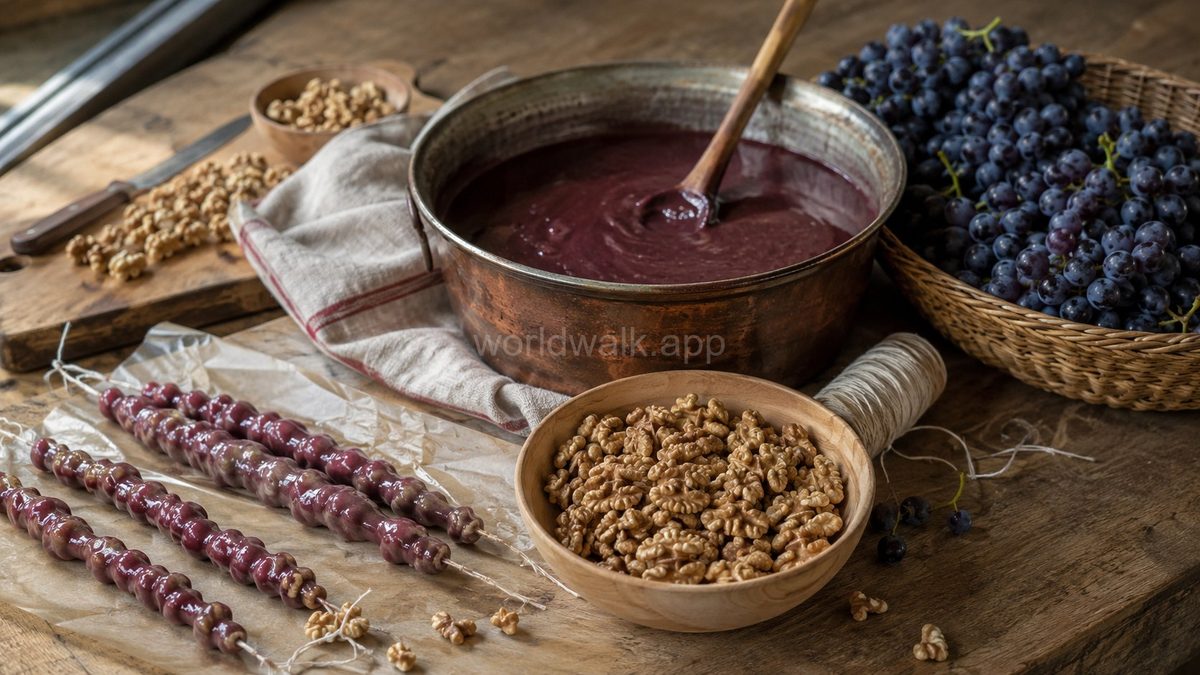
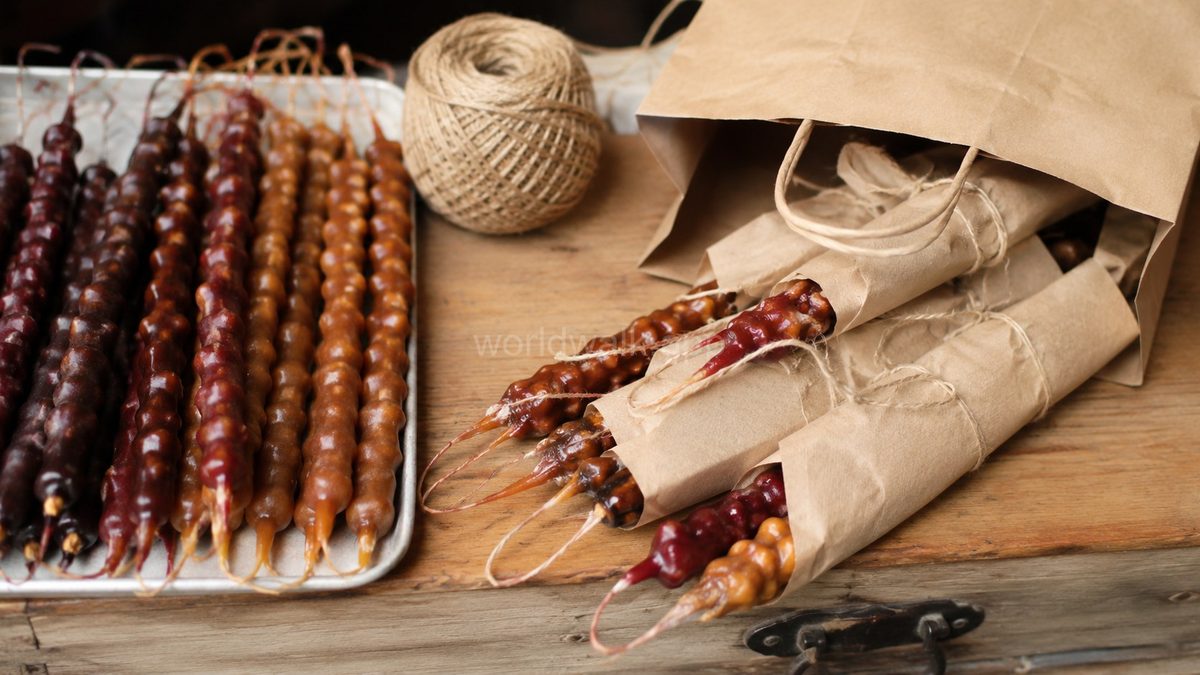
Churchkhela is made by threading nuts — most commonly walnuts, though hazelnuts and other varieties are also used depending on the region and the producer — onto a string. That string is then dipped repeatedly into thickened grape juice, grape must, or another fruit-based mixture. Between each dipping, the coating is allowed to set. After enough layers have built up, the churchkhela is hung to dry until firm.
Also from WorldWalk
The Port Where Empires Met and Mixed — a separate 46-stop Batumi walking tour, about 2.5 hours. Available on VoiceMap.
Explore the tour on VoiceMap → Start our tour in Telegram →The result is something dense, chewy, and distinctly Georgian: a soft-to-firm outer shell of concentrated fruit around a core of whole nuts.
It is not a candy in the modern industrial sense. It is closer to a traditional dried fruit-and-nut sweet — something that can be carried, kept for a reasonable period, and eaten in small amounts.
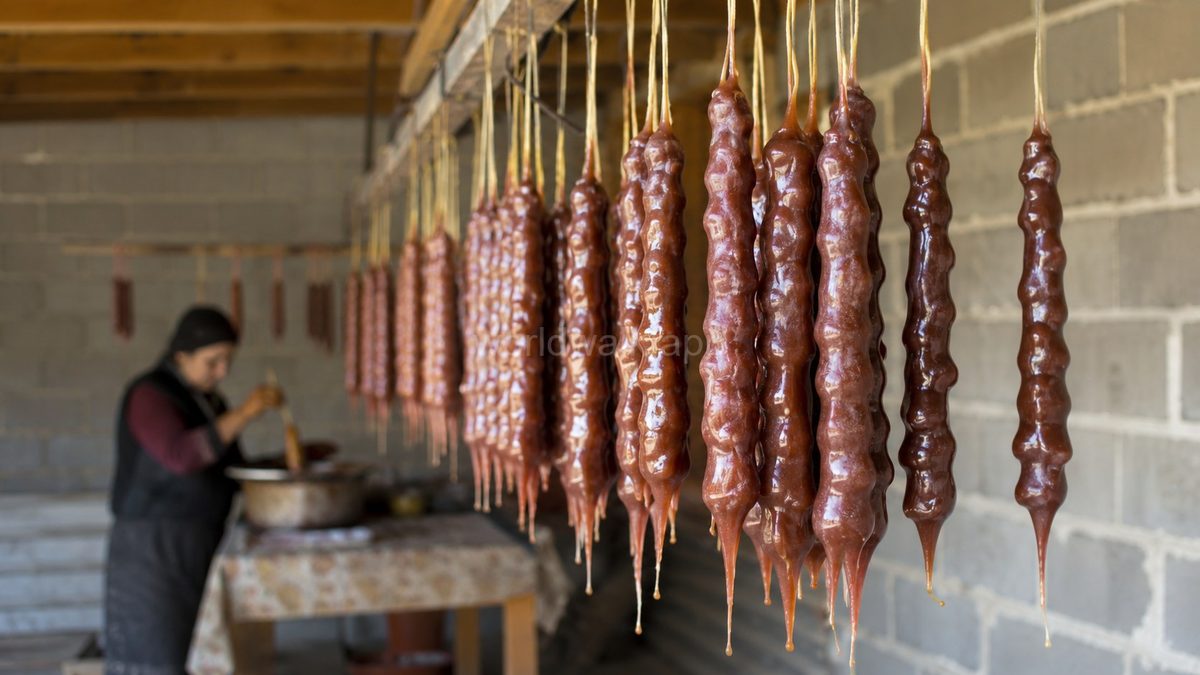
What Is Churchkhela Made Of?
The basic ingredients are straightforward:
- Nuts — usually walnuts or hazelnuts, sometimes a mix
- Grape juice or grape must — reduced down until thick, often called tatara or pelamushi in Georgian cooking
- Flour or another starch — used as a thickener for the coating mixture
- Sometimes other fruit juices — pomegranate, mulberry or others, which affect both the colour and the flavour
The colour of the outer coating often reflects the fruit base used. Darker reds and purples generally suggest grape or pomegranate. Lighter amber or yellow tones may point to a different fruit mixture.
Quality and ingredients vary considerably. In tourist-facing areas, some churchkhela is made to a simpler recipe or with a shorter production process. If you want to know exactly what is in what you are buying, it is worth asking.
In western Georgia, including regions closer to Batumi, you may also come across a similar sweet called janjukha. It is prepared in a similar way, but often uses hazelnuts and a corn-flour-thickened grape mixture rather than the more Kakhetian walnut-and-wheat-flour version.
What Does Churchkhela Taste Like?
The outside is chewy — sometimes quite firm if the churchkhela has been well dried, softer if it is fresher. The coating has a concentrated fruit flavour: grape-forward in many versions, sometimes with a gentle tartness. When well made, it is mildly sweet rather than sugary, and the fruit flavour is present without being heavy.
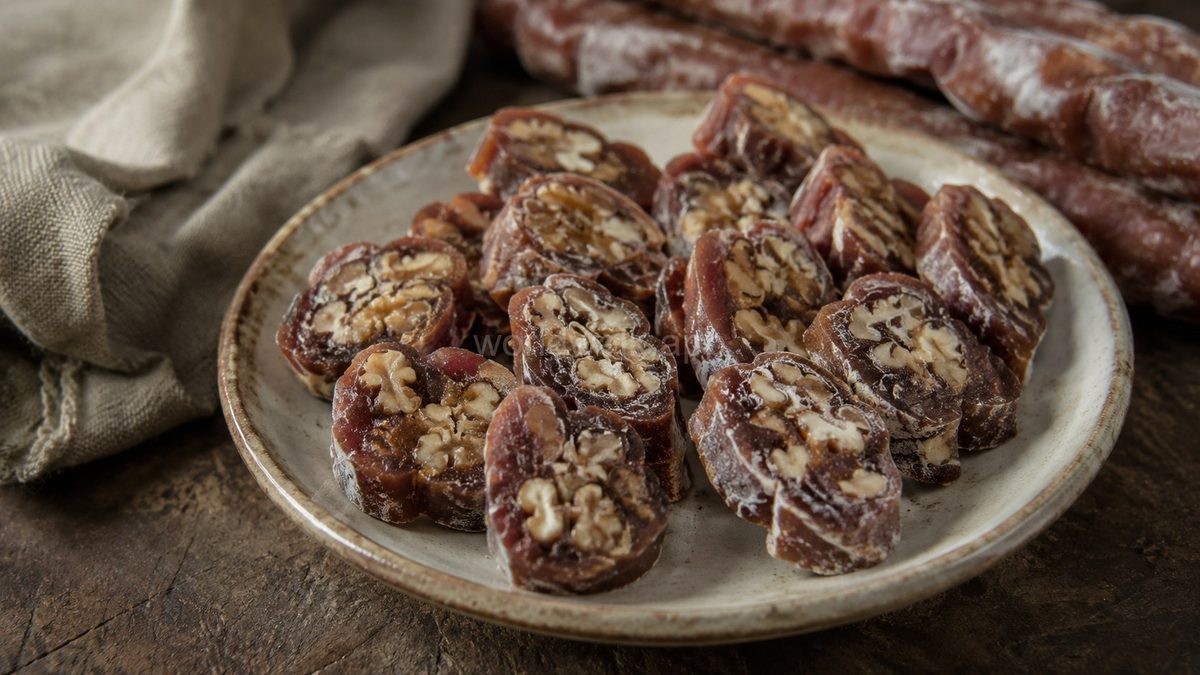
Inside, the nuts add texture and a nutty richness that balances the sweetness of the coating. Walnuts bring a slight bitterness; hazelnuts are milder and creamier.
The overall experience is dense and satisfying. A single piece goes a long way.
The WorldWalk Batumi audio tour covers 29 stops through the Old Town, port, Turkish Quarter and surrounding streets — audio stories, photos and Google Maps links at every stop. Self-guided, at your own pace.
Start the audio tour →Is Churchkhela Georgian?
Churchkhela is strongly associated with Georgia and is considered one of the country's most recognisable traditional foods. It appears in Georgian food culture across regions, seasons and household traditions.
Similar nut-and-fruit sweets exist in the wider region — the Caucasus and parts of the Middle East have their own versions of nuts coated in thickened fruit syrups — but churchkhela, in this name and familiar Georgian form, is strongly rooted in Georgian culinary tradition.
How to Choose Good Churchkhela
Not all churchkhela is the same. A few practical things to consider:
Smell it first. Good churchkhela has a pleasant, naturally sweet aroma. If it smells off, move on.
Ask what nuts are inside. Walnuts are common; hazelnuts are also good. Some cheaper versions may use lower-quality nuts. If the seller cannot tell you, that is itself useful information.
Ask about the fruit base. Is it made with grape juice? Pomegranate? Another fruit? This affects both flavour and colour.
Look at the condition. Avoid pieces that look excessively dusty, cracked or very old. A fine, dry white bloom can be normal — often it is sugar rising to the surface as the churchkhela dries. But avoid pieces with a musty smell, damp spots or anything that looks like mould rather than a dry powdery coating.
Think about texture. Softer churchkhela is often fresher. Firmer pieces have been dried longer. Neither is wrong, but the texture affects how you eat it.
Very bright colours are not automatically a problem, but they are worth asking about. Some vivid colours come from natural fruit bases; others may not.
Buy one piece first. Before committing to a bag, try a single piece. This is the most reliable way to know whether you like what you are getting.
How to Eat Churchkhela
Churchkhela is usually eaten sliced with a knife, though biting directly into it also works if it is soft enough. It pairs well with tea or coffee, and it makes a practical snack for walking or day trips — compact, non-sticky and dense enough to be satisfying in small amounts.
Because it is rich and filling, a little tends to be enough. It is not something most people eat in large quantities at once.
Is Churchkhela a Good Souvenir?
For many travellers, churchkhela makes a good edible souvenir from Georgia. It is compact, easy to pack, clearly connected to Georgian food culture, and something that most people back home will not have encountered before.
A few things to consider before buying a large amount:
- Check customs rules. Food products, including dried sweets, may be subject to restrictions when crossing certain borders. Check the regulations for your destination country before buying to take home.
- Pack it carefully. Churchkhela can leave marks on fabric if handled roughly in a bag.
- Ask about shelf life. Well-dried churchkhela keeps for a reasonable time, but the seller should be able to give you a rough guide.
- Consider the weather. In hot conditions, softer churchkhela is more prone to sticking or deteriorating.
- Try before buying many. Quality varies. One piece first is always the right approach.
Churchkhela and Georgian Food Culture
Churchkhela is not a standalone product. It sits within a broader Georgian food culture that centres on grapes, walnuts, seasonal produce, home-style preparation and the kind of food that has been made the same way for a long time.
The connection to Georgian wine culture is direct. Grape juice and grape must are central to many versions of churchkhela, and the same vine-based ingredients that go into Georgian wine also shape the character of this sweet. In the wine-producing regions of Georgia, you are likely to find churchkhela made by small producers, sometimes from grapes grown on their own land.
Understanding churchkhela as part of this wider food culture — rather than just as a tourist product — tends to make it more interesting to eat and easier to buy well.
Where to Buy Churchkhela in Georgia
Churchkhela is widely available across Georgia. The types of places where you are most likely to find it include:
- Local markets in Batumi, Tbilisi, Kutaisi and other cities
- Small grocery shops and food stalls in most Georgian towns
- Tourist souvenir areas in city centres — convenient, but often more expensive
- Roadside stalls, especially on routes through wine-producing regions
- Wine regions and family producers, where you may find churchkhela made from locally grown grapes
Where to Buy Churchkhela in Batumi
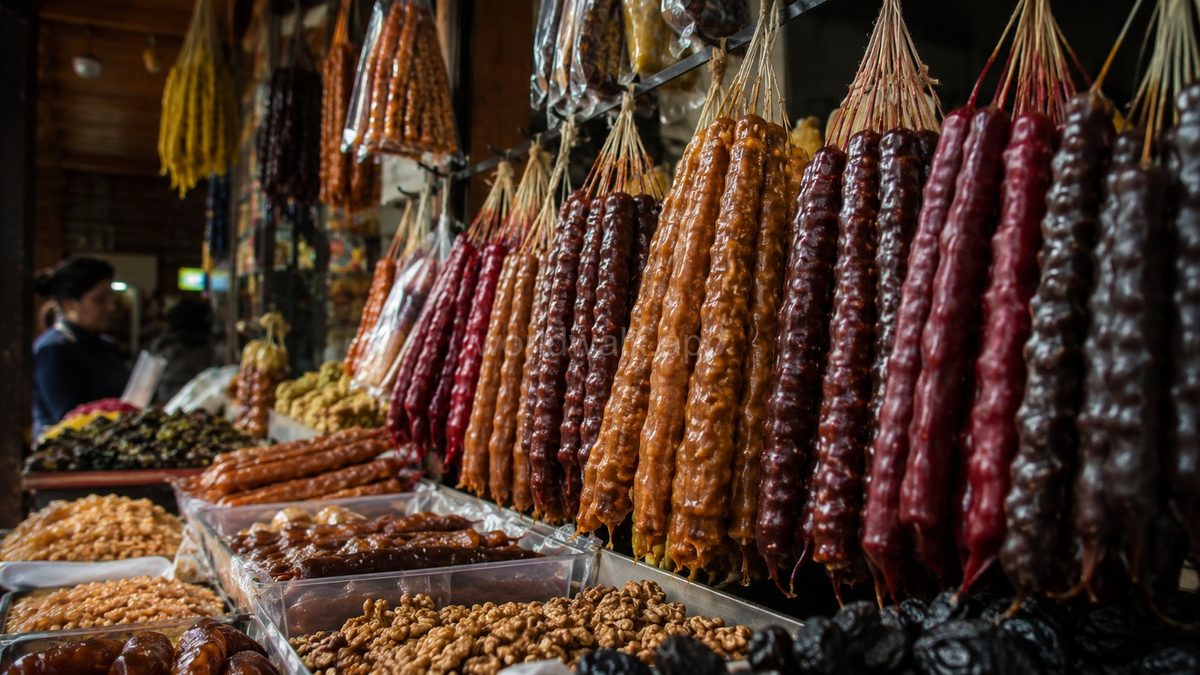
In central Batumi, churchkhela is easy to find. Tourist streets, small shops and souvenir areas all sell it, and you will rarely need to walk far to spot a hanging bunch. If you only want to try one piece, buying it in the centre is perfectly fine.
If you want to buy many pieces — as gifts or edible souvenirs — the centre may not be the best option. Prices there can be considerably higher than in more local market settings, and the selection is often narrower.
For larger purchases, Boni Market is the place to go. It is a more everyday food market where local products are sold alongside general produce, and it has the best prices and the biggest selection of churchkhela in Batumi. If you want it fresh and in quantity, for gifts to take home, this is where to buy it. You can compare many stalls, ask about ingredients and texture, and try a piece before buying a bag.
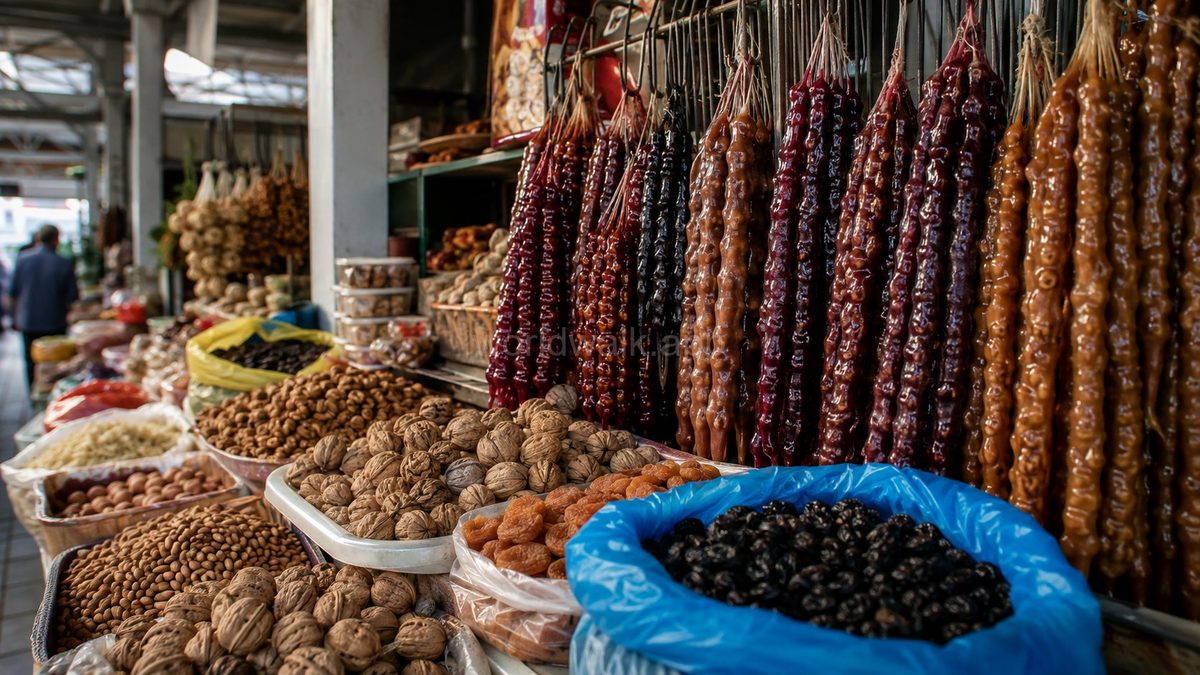
A practical summary for Batumi: one piece in the centre is fine; for fresh churchkhela in bulk, go to Boni Market.
A Short Note for Travellers in Batumi
If you are spending time in Batumi, churchkhela is one of those small details that is worth noticing properly rather than simply buying quickly and moving on. Watching how it is displayed, asking a few questions, and trying a piece in a market rather than a tourist shop tends to give you a better sense of what it actually is.
Food details like this — small, ordinary, specific — are part of what makes a place legible. They appear when you slow down enough to look.
FAQ
What is churchkhela made of?
Churchkhela is made from nuts — usually walnuts or hazelnuts — threaded onto a string and dipped repeatedly into thickened grape juice, grape must or another fruit-based liquid. A starch or flour is typically used to thicken the coating. Ingredients and quality vary depending on the producer and the region.
Is churchkhela Georgian?
Yes. Churchkhela is considered one of Georgia's most recognisable traditional foods and is deeply embedded in Georgian food culture. Similar nut-and-fruit sweets exist elsewhere in the region, but churchkhela in its characteristic form belongs to Georgian culinary tradition.
What does churchkhela taste like?
The outside is chewy and fruit-flavoured — often grape-forward, sometimes with a light tartness. The inside is nutty. When well made, it is mildly sweet rather than sugary. The texture can range from soft and fresh to quite firm if it has been well dried.
Where can I buy churchkhela in Batumi?
You will find churchkhela throughout central Batumi — in tourist streets, small shops and souvenir areas. For larger purchases, Boni Market offers a more local food-market setting with more variety. Try one piece before buying a bag.
Is churchkhela a good souvenir from Georgia?
It can be. Churchkhela is compact, carries easily, and is closely connected to Georgian food culture. Before buying a large amount to take home, check customs rules for your destination, ask about shelf life, and try one piece first.