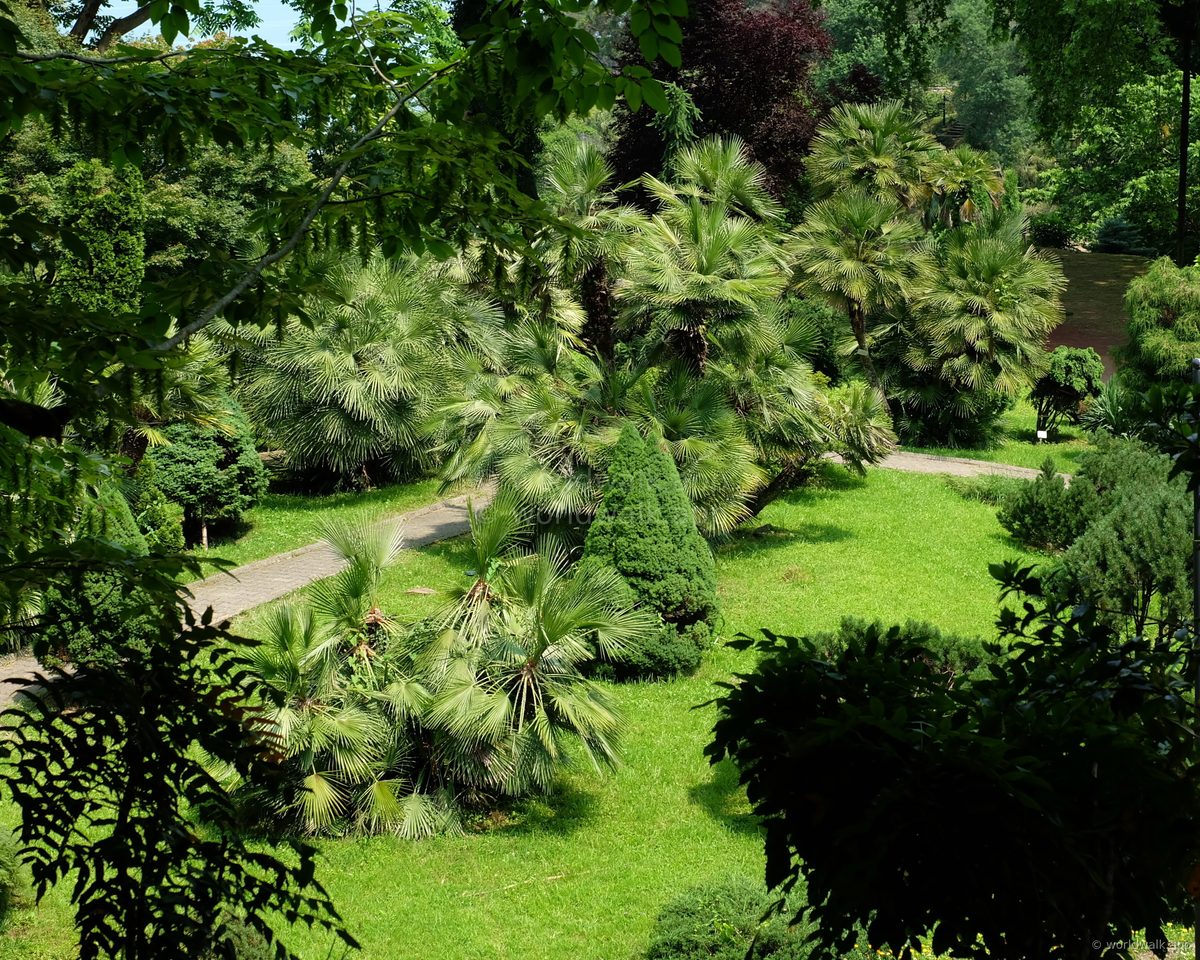
Where is it? At Green Cape (Mtsvane Kontskhi), roughly 9 km north of central Batumi along the coast.
How long do you need? Three to four hours to do it properly. Two if you are moving quickly and skipping the lower sections.
How do you get there? Marshrutka No. 31 from the city, or bus No. 10 / 10a, or a taxi through Bolt. All are simple.
The key trick: get dropped at the upper entrance and walk down towards the sea. The route becomes a descent instead of a climb.
Best time of day: morning, or from about 16:00 onwards. Midday in July and August is hot and exposed on the upper paths.
Best time of year: April to June, when the magnolias, rhododendrons and azaleas are flowering. September and October are quieter and still green.
What the Batumi Botanical Garden Actually Is
The garden was founded by the Russian botanist and geographer Andrei Krasnov, who chose this stretch of coast because of an unusual piece of geography: the Adjaran coastline is humid, subtropical and frost-free enough that plants from wildly different climate zones survive here side by side. Krasnov collected specimens across Asia and the Americas and planted them on this hillside to see what would take. Most of it took.
The result is a collection spread over more than a hundred hectares, arranged into geographical sections — East Asia, North America, New Zealand, Australia, the Himalayas, Mexico, the Mediterranean and the Transcaucasian humid subtropics. Krasnov is buried in the garden, on a terrace with a view of the sea he chose the site for.
For a visitor, the practical consequence is that the garden does not feel like a botanical collection in the tidy, labelled, municipal sense. It feels like a series of small forests that gradually change character as you walk, with the Black Sea appearing between the trees every few minutes.
The Walking Route: Do It Downhill
This is the part worth planning.
The garden runs along a slope, from an upper area near the highway down towards the sea and the Green Cape shoreline. There is more than one entrance, and which one you use changes the whole experience.
The mistake: entering at the lower main gate and walking up. You climb for most of the visit, in humidity, and you are tired by the time you reach the best viewpoints.
The better version: ask a taxi to take you to the upper entrance, then walk down through the sections towards the sea and exit at the bottom. Everything is a gentle descent, the viewpoints arrive early while you are still fresh, and you finish near the coast.
If you arrive at the lower entrance anyway, there is an internal shuttle (a small electric vehicle) that runs along the main path. Taking it up and walking back down achieves the same thing. Availability and fares vary by season — ask at the ticket office when you arrive.
A rough sequence walking downhill
- Upper terraces and the main viewpoint. The widest view of the coastline, the sea and — on a clear day — the Batumi skyline in the distance. Worth stopping properly rather than photographing and moving on.
- East Asian section. Bamboo, Japanese maples, camellias. The most atmospheric part of the garden in light rain, which Batumi supplies generously.
- Himalayan and North American sections. Taller, denser, cooler. Good shade on a hot day.
- Krasnov's grave and the memorial area. A short detour, and a useful bit of context for what the whole place is.
- Mediterranean and Australian sections. Drier planting, eucalyptus, more open light.
- Colchic forest and the descent to the sea. The native Georgian section — this is roughly what the entire coast looked like before the garden existed.
- Green Cape shoreline. Exit at the bottom and you are essentially at the beach.
Allow three hours for this at a normal pace. Four if you stop, sit, and let the place work.
Read also: Batumi Travel Guide 2026
Practical Details
Tickets. Bought at the entrance gates. The ticket price is modest by European standards, with reduced rates for children and students. Prices are adjusted periodically, so check at the gate rather than relying on figures published online.
Opening hours. The garden opens in the morning and closes in the evening, with shorter hours in winter. The last entry is typically well before closing time, so do not arrive an hour before the gates shut expecting to see much.
Food and water. There are cafés and kiosks near the entrances and a couple of drink stands along the main path, but the interior is largely unserviced. Bring water — more than you think, in summer — and something to eat if you plan a long visit.
Shoes. Paths are paved along the main route, but the side trails are earth and become slippery after rain. Batumi rain is frequent enough that this is worth planning for.
Pushchairs and accessibility. The main paved route is manageable with a pushchair going downhill, but several side sections involve steps and steep unpaved sections. Visitors with limited mobility should stick to the main path and consider the shuttle.
Toilets. Available near the entrances and at a couple of points along the main route.
How to Get to the Botanical Garden from Batumi
Marshrutka No. 31. The standard local option. It runs north along the coast and terminates near the main entrance, so you cannot miss the stop. Departures are frequent through the day. Fares are paid by card — Batumi's public transport does not accept cash, so read the notes in how to get around Batumi before you rely on it.
Bus No. 10 and 10a. Municipal buses that run north through Makhinjauri towards the garden. Slightly slower than the marshrutka, same card-payment rules.
Taxi or Bolt. The simplest option, especially for two or more people, and the only one that lets you specify the upper entrance. The journey from central Batumi takes roughly 20–25 minutes depending on traffic. Book through the app rather than negotiating at the roadside — the difference in price is significant.
Train. Local trains along the coast stop at Makhinjauri and Chakvi, both near the garden, but the timetable is sparse and the walk from the station is longer than most people expect. Not the practical choice unless you are already travelling that line.
Getting back is easier than getting there: taxis wait near both main gates, and the marshrutka runs until evening. If you exit at the lower gate near the sea, you can also simply walk to Green Cape beach and order a car from there.
Read also: How to Get Around Batumi
When to Go
April to June is the garden at its best. The rhododendrons, azaleas, magnolias and wisteria flower through spring, the temperature is comfortable for a long walk, and the light is good. May is the strongest single month.
July and August work if you go early or late. The middle of the day is genuinely hot and the upper terraces have limited shade. The advantage of summer is that you can finish at the sea and swim.
September and October are underrated. Fewer visitors, the greenery still intact, softer light, and the sea still warm enough to swim afterwards.
November to March is quiet and often wet. The evergreen sections — bamboo, camellias, laurels — carry the garden through winter, and the place has a genuinely different atmosphere in mist. Fewer facilities operate, and paths can be slippery. See Batumi in November for what off-season travel here is generally like.
What to Combine It With
The garden sits on the same stretch of coast as several other things worth an hour:
- Green Cape beach (Mtsvane Kontskhi) — directly below the garden, quieter than the city beaches, and the natural way to end the visit. See Batumi beaches for how it compares.
- Makhinjauri — the small coastal settlement between the city and the garden, with a beach and a railway station.
- Chakvi — tea-growing country north of the garden, and the historical reason this coastline was planted with subtropical crops in the first place.
A common and sensible half-day: garden in the morning, lunch at Green Cape, swim, taxi back into Batumi by mid-afternoon. That leaves the evening free for the Old Town and the Boulevard.
Is It Worth It?
Yes — with one honest caveat. If you dislike walking, or if you have two hours and a strong preference for sitting down, the Botanical Garden will feel like a long way to go for some trees.
For everyone else it is the best thing within half an hour of Batumi. It is the one place near the city where the landscape, rather than the architecture, is the point, and it explains something about Adjara that the seafront does not: this is a subtropical coast, wet and warm and absurdly fertile, and the reason Batumi looks the way it does begins with the climate.
Do it downhill, bring water, and give it more time than you planned.
Frequently Asked Questions
How much time do you need at Batumi Botanical Garden?
Three to four hours for the full route at a comfortable pace. Two hours covers the upper terraces and the main viewpoints if you are short on time.
How do you get to Batumi Botanical Garden without a car?
Marshrutka No. 31 or bus No. 10 / 10a from Batumi, or a taxi via Bolt. All take roughly 20–30 minutes. Public transport fares are paid by card, not cash.
Is the Botanical Garden uphill?
The site is on a slope. Entering at the upper gate and walking down turns the whole visit into a descent — this is the single most useful piece of planning for the trip.
Can you swim near the Botanical Garden?
Yes. Green Cape beach is directly below the lower part of the garden, and it is quieter than central Batumi's beaches.
When is the best time to visit?
April to June for flowering and comfortable temperatures. September and October for fewer people and warm sea. Avoid the middle of the day in July and August.
Is it suitable for children?
Yes, if you take the downhill route and use the internal shuttle where needed. The distances are long for small children walking the full route unaided.
Back in the city afterwards, the Batumium: Discover the Essence of Batumi self-guided audio tour covers the Old Town on foot, with the port, oil trade and empire history that shaped it.
Start the Batumium audio tour →